

Biosimilar Interchangeability Checker
Check if a biologic drug has FDA-interchangeable biosimilar options and view state-specific substitution laws.
Enter a biologic drug name to check its interchangeability status and state substitution laws.
As of late 2023, 7 biosimilars had received FDA interchangeability designation, including:
- Two insulin products
- Three for inflammatory conditions like rheumatoid arthritis
- Two for eye diseases
The Purple Book isn’t a novel you read for fun-it’s the FDA’s official, searchable database that tells pharmacists, doctors, and patients exactly which biological drugs are biosimilars, which are interchangeable, and how they connect to the original brand-name products. Think of it as the rulebook for biologics in the U.S. healthcare system. Unlike generic pills, biological drugs are made from living cells, making them far more complex. That’s why the FDA created a special system to track them-and the Purple Book is where all that information lives.
What Exactly Is the Purple Book?
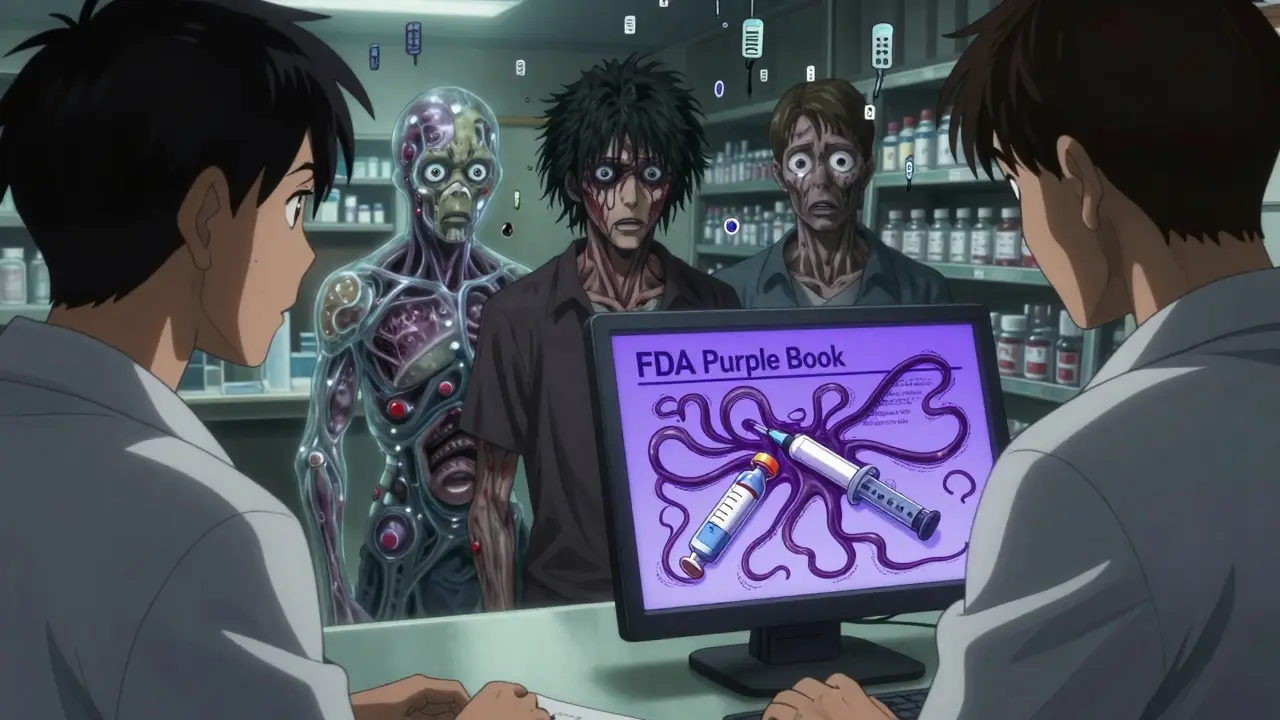
The Purple Book is a digital compendium maintained by the U.S. Food and Drug Administration. It lists every FDA-approved biological product, including the original reference drugs and their biosimilar and interchangeable versions. Before 2020, this information was split across two separate lists-one for drugs regulated by CDER (like insulin and monoclonal antibodies) and another for CBER products (like vaccines and blood products). Now, it’s all in one place. That makes it easier for pharmacists to check if a drug they’re about to dispense is a biosimilar or interchangeable, and which reference product it matches.Each product card in the Purple Book shows the brand name, generic name, and the date it was licensed. It also flags whether the product is a 351(a) reference product, a 351(k) biosimilar, or a 351(k) interchangeable. The colors match up: if a biosimilar shares the same color card as the reference product, it means they’re linked. You’ll also see icons for delivery methods-autoinjectors, prefilled syringes, vials-so you know how the drug is administered.
Biosimilars vs. Interchangeable Products: The Key Difference
Not all biosimilars are created equal. A biosimilar is a biological product that’s highly similar to its reference drug, with no clinically meaningful differences in safety, purity, or potency. That means it works the same way in the body. But here’s the catch: just because a product is a biosimilar doesn’t mean a pharmacist can swap it in automatically.An interchangeable product goes one step further. To earn that label, the manufacturer must prove that switching between the biosimilar and the original reference drug-multiple times, back and forth-won’t increase risk or reduce effectiveness. That’s not just about one dose. It’s about repeated switching, like changing brands every month. The FDA requires clinical studies showing that patients who alternate between the two get the same results as those who stick with the original.
So, all interchangeable products are biosimilars. But only a few biosimilars are interchangeable. As of late 2023, only seven products had received the interchangeable designation from the FDA. These include two insulin products, three for inflammatory conditions like rheumatoid arthritis, and two for eye diseases. The rest are biosimilars without interchangeability.
Why Interchangeability Matters for Pharmacists
This distinction has real-world consequences. If a doctor prescribes Humira, and a biosimilar version is available but not interchangeable, the pharmacist must dispense exactly what’s written on the prescription. No substitutions allowed.But if the biosimilar is labeled as interchangeable, the pharmacist can swap it in-just like they would with a generic pill. However, even then, it’s not automatic. State laws control what happens at the pharmacy counter. As of 2023, 47 states and Puerto Rico allow pharmacists to substitute an interchangeable biosimilar without contacting the prescriber. But in those states, they still have to notify the patient and keep records. In the other three states, the pharmacist must get the doctor’s permission first.
This patchwork of rules creates confusion. A pharmacist in Texas might swap a biosimilar without a call to the doctor. One in New York might need a signature. The Purple Book tells you what’s federally approved-but you still need to check your state’s pharmacy board rules to know what you can actually dispense.
How the FDA Determines Interchangeability
Getting the interchangeable label isn’t easy. The FDA doesn’t just look at lab data or one clinical trial. They demand switching studies-where patients are moved back and forth between the reference product and the biosimilar over weeks or months. The goal? Prove that switching doesn’t cause more side effects, flare-ups, or loss of effectiveness.For example, if a patient with Crohn’s disease is on a reference biologic and switches to an interchangeable biosimilar, then switches back, their disease activity should stay stable. No spikes. No drop in response. The FDA’s guidance says the risk must be no greater than if they never switched at all.
Importantly, the FDA stresses that interchangeable doesn’t mean better. It doesn’t mean safer. It just means the switching process is predictable and safe. A non-interchangeable biosimilar works just as well as the reference drug-its only limitation is that it can’t be swapped without a doctor’s okay.
What’s Not in the Purple Book
The Purple Book doesn’t list every biologic on the market. It only includes products approved under the Biologics Price Competition and Innovation Act (BPCIA) of 2010. That means older biologics, approved before 2010, aren’t included unless they’ve been re-evaluated under the new pathway.It also doesn’t include "unbranded biologics." These are products that are equivalent to a brand-name drug but were approved under older rules. The FDA considers them equivalent, but they’re not classified as biosimilars or interchangeable under the BPCIA. So if you’re looking for a substitute, make sure you’re checking the right category.
And while the Purple Book tells you what’s approved, it doesn’t tell you what insurance will cover. That’s a separate battle. Even if a biosimilar is interchangeable, a payer might still require prior authorization or prefer the brand-name drug. The Purple Book gives you the facts. It doesn’t fix your pharmacy benefit manager’s formulary.
How to Use the Purple Book
The database is free and searchable on the FDA’s website. You can search by brand name, generic name, or manufacturer. If you type in "Enbrel," you’ll see the original product and any biosimilars linked to it. Click on a biosimilar, and you’ll see its approval date, interchangeability status, and whether it’s approved for the same uses as the reference drug.For pharmacists, this is a daily tool. When a prescription comes in for a biologic, they pull up the Purple Book to check if a biosimilar is available and whether they can substitute it. For doctors, it helps when discussing cost-saving options with patients. For patients, it’s a way to verify that the drug they’re getting is legitimate and approved.
The FDA has also made it user-friendly. The search results are grouped under the reference product. You don’t have to scroll through dozens of unrelated drugs. Everything is organized. And the color-coded cards make it easy to spot matches at a glance.
The Future of Biosimilars and the Purple Book
More biosimilars are coming. Companies are actively submitting applications for interchangeability, especially for high-cost drugs like Humira, Enbrel, and Remicade. The first interchangeable insulin products hit the market in 2021, and since then, the number has grown. Experts expect at least a dozen more interchangeable biosimilars to be approved by 2026.But progress isn’t just about approvals. It’s about adoption. Even with federal backing, pharmacy substitution still depends on state laws and payer policies. Until those barriers break down, the full cost-saving potential of biosimilars won’t be realized.
The Purple Book is evolving too. The FDA has released draft guidance on labeling for biosimilars and interchangeable products, aiming to make prescribing and dispensing clearer. They’re also working on better tools to help providers understand which products are interchangeable across states.
For now, the Purple Book remains the most reliable source for up-to-date, official information on biological products in the U.S. It’s not perfect, but it’s the only place you can go to find out, with certainty, whether a drug is interchangeable-and what that actually means for your care.
What is the Purple Book used for?
The Purple Book is the FDA’s official database that lists all approved biological products, including reference drugs, biosimilars, and interchangeable products. It helps healthcare providers, pharmacists, and patients identify which biologics are biosimilar to or interchangeable with a reference product, ensuring safe and accurate prescribing and dispensing.
Can a pharmacist substitute a biosimilar for a brand-name biologic?
Only if the biosimilar has been designated as "interchangeable" by the FDA AND your state allows substitution without prescriber approval. In 47 states and Puerto Rico, pharmacists can substitute an interchangeable biosimilar without contacting the doctor. In the remaining states, they must get permission first. Non-interchangeable biosimilars cannot be substituted at all.
Is an interchangeable biosimilar better than a regular biosimilar?
No. An interchangeable biosimilar is not safer or more effective than a non-interchangeable one. Both are equally effective and safe. The only difference is that the interchangeable version has been proven to work just as well when switched back and forth with the reference product. The designation is about predictability during substitution, not superiority.
How many interchangeable biosimilars are approved in the U.S.?
As of late 2023, seven biosimilars had received FDA interchangeability designation. These include two insulin products, three for inflammatory diseases like rheumatoid arthritis, and two for eye conditions. More are expected to be approved in the coming years.
Why doesn’t the Purple Book include all biologics?
The Purple Book only includes biological products approved under the BPCIA of 2010. Older biologics approved before 2010 are not listed unless they’ve been re-evaluated under the new biosimilar pathway. It also doesn’t include unbranded biologics, which are considered equivalent but not classified as biosimilars under current law.
Do insurance companies cover interchangeable biosimilars the same as brand-name drugs?
Not always. Even if a biosimilar is FDA-interchangeable, insurance plans may still require prior authorization, step therapy, or favor the brand-name drug. The Purple Book tells you what’s approved, but coverage depends on your pharmacy benefit manager’s formulary rules.
Lynsey Tyson
December 19, 2025 AT 06:52I used to think biosimilars were just cheap knockoffs until I saw my cousin’s insulin bill drop by 70% after switching. The Purple Book saved us months of confusion-now I check it before every refill. No fluff, just facts.
Pharmacists should be trained on this like they are on generics. It’s not magic, it’s science-and patients deserve to know their options.
Dikshita Mehta
December 20, 2025 AT 05:19For those unfamiliar with the BPCIA, the Purple Book is essentially the FDA’s attempt to bring transparency to a notoriously opaque corner of pharma. Before 2010, biologics were essentially immune to competition because the regulatory path didn’t exist. Now, we have a roadmap.
What’s fascinating is how the interchangeable designation mirrors the ‘A-rated’ status for generics-but with exponentially more complexity. The switching studies? They’re not just about efficacy. They’re about immunogenicity over time, which is a nightmare to prove.
And yes, insurance still fights it. But at least now we have a public, searchable source to cite when pushing back.
Gloria Parraz
December 20, 2025 AT 15:02Let me tell you-my mom has rheumatoid arthritis and was on Humira for 12 years. When the first interchangeable biosimilar hit, her pharmacy switched her without asking. She panicked. Thought they gave her the wrong drug.
I had to sit her down with the Purple Book. Showed her the color-coded cards. Explained that the biosimilar wasn’t ‘lesser’-it was identical in every way that mattered. She cried. Not from sadness-from relief.
People don’t fear price cuts. They fear change. The Purple Book is the bridge between fear and trust. And we need more of that.
Nicole Rutherford
December 20, 2025 AT 15:59Oh please. The FDA says it’s ‘safe’-but have you seen the post-marketing data? Biosimilars are rushed through because Big Pharma wants to kill the brand-name profits. The ‘interchangeable’ label is just a marketing trick to get pharmacists to swap without telling patients.
I’ve seen patients get rashes, fatigue, flares after switching. They’re told it’s ‘just adjustment.’ Bullshit. The studies are too short. The real effects show up after 18 months. And the Purple Book? It’s just a PR tool. Don’t be fooled.
Mark Able
December 20, 2025 AT 19:37Wait, so if I’m on a biosimilar and my insurance wants me to switch to another one-can they? Like, back and forth? Is that even legal? I thought only the original could be swapped with the interchangeable one.
Also, why does the Purple Book not list prices? That’s the whole point, right? I don’t care if it’s ‘interchangeable’ if it still costs $5K a month.
Someone explain this to me. I’m lost. And I’m a nurse. I should know this.
Dorine Anthony
December 21, 2025 AT 02:17Just wanted to say thanks to whoever wrote this. I’m a pharmacy tech in rural Ohio and we get 3 biosimilar prescriptions a week. Before this, I was Googling half the time. Now I have the Purple Book bookmarked.
Also-state laws are a mess. We can substitute in Ohio, but only if the patient signs a form. And we have to call the doctor if they’re under 18. No one tells you that in med school.
Janelle Moore
December 21, 2025 AT 15:13THE PURPLE BOOK IS A GOVERNMENT TRAP. THEY WANT YOU TO SWITCH TO CHEAP DRUGS SO THEY CAN CUT MEDICAID BUDGETS. THE FDA ISN’T LOOKING FOR SAFETY-THEY’RE LOOKING FOR WAYS TO MAKE YOU DEPENDENT ON BIG PHARMA’S NEW VERSIONS.
THEY’RE HIDING THE FACT THAT BIOSIMILARS CONTAIN TOXIC STABILIZERS THAT CAUSE AUTOIMMUNE FLARES. I’VE SEEN IT. MY NEIGHBOR DIED AFTER SWITCHING. NO ONE TALKS ABOUT IT.
THEY WON’T LET YOU SEE THE RAW DATA. THE PURPLE BOOK IS A LIE. CHECK THE FDA’S CONTRACTS WITH THE MANUFACTURERS. THEY’RE ALL CONNECTED.
THEY’RE USING THIS TO CONTROL THE POPULATION. IT’S NOT ABOUT HEALTH. IT’S ABOUT CONTROL.
Henry Marcus
December 23, 2025 AT 07:05Let’s be real: the Purple Book isn’t a database-it’s a bureaucratic theater. The FDA gives out the ‘interchangeable’ stamp like it’s a participation trophy. Meanwhile, the real players-the insurers, the PBMs, the hospital formularies-are still playing 4D chess with your prescriptions.
And don’t get me started on the ‘color-coded cards.’ Who thought that was a good idea? It’s like a kindergarten chart for adults who can’t read the fine print.
Meanwhile, patients are getting switched like socks in a laundry basket. No one’s tracking long-term outcomes. No one’s asking if the immune system remembers the original. We’re all lab rats in a patent-expiration game.
And the worst part? The Purple Book doesn’t even tell you which biosimilar is cheaper. That’s up to your insurance’s secret algorithm. So congrats, FDA-you built a beautiful, useless monument to transparency.
Aadil Munshi
December 23, 2025 AT 07:33It’s ironic, isn’t it? We live in a world where we can track our sleep cycles via smartwatches, yet we still can’t tell if our insulin is ‘interchangeable’ without consulting a 400-page PDF from a government agency.
The Purple Book is a marvel of regulatory engineering-but it’s also a monument to how broken our healthcare system is. If a drug can be safely swapped, why do we need 47 different state laws to decide if it’s allowed?
And why is the burden of understanding this on the patient? Or the pharmacist? Not the prescriber? Not the insurer?
It’s like giving someone a map to a treasure chest… but hiding the key under a pile of bureaucracy. The Purple Book doesn’t solve access-it just documents how hard access is.
Frank Drewery
December 24, 2025 AT 07:56I work in a clinic where 60% of our patients are on biologics. The Purple Book has been a game-changer. We print out the product cards and hand them to patients. It’s not glamorous, but it’s honest.
One lady came in crying because her pharmacy switched her to a biosimilar and she thought it was a mistake. We opened the Purple Book together. Showed her the color match. She hugged me.
It’s not about politics or profits. It’s about dignity. People deserve to understand what’s going into their bodies. And this tool? It gives them that power.
Danielle Stewart
December 25, 2025 AT 01:41As a clinical pharmacist, I’ve spent years advocating for biosimilar adoption. The Purple Book is the single most underutilized resource in the entire healthcare ecosystem. We teach medical students about it in one 15-minute lecture. That’s it.
Meanwhile, pharmacists are expected to be experts on complex biologic pathways, interchangeability criteria, state substitution laws, and payer formularies-all while managing 200 prescriptions a day.
The FDA built the tool. The profession needs to build the training. Until then, patients are stuck in the middle of a regulatory vacuum.
Let’s stop treating this like a trivia question and start treating it like a patient safety issue.
mary lizardo
December 25, 2025 AT 21:17One must question the legitimacy of this entire framework. The FDA’s definition of ‘interchangeability’ is a legally constructed fiction designed to appease cost-cutting interests under the guise of scientific rigor. The notion that repeated switching poses no additional risk is empirically unsubstantiated in longitudinal data.
Moreover, the use of color-coded cards and simplified icons is a patronizing attempt to democratize access to information that, in truth, requires specialized pharmacological training to interpret correctly.
One cannot reduce complex immunological equivalence to a visual metaphor. The Purple Book is not a tool of transparency-it is a tool of obfuscation, dressed in the clothing of accessibility.