
When bones are crumbling, not all treatments are created equal
If you’ve been diagnosed with severe osteoporosis-especially with a hip T-score below -3.0-you’re not just fighting low bone density. You’re fighting the risk of a fracture that could change your life forever. That’s where anabolic agents like teriparatide and
How teriparatide and abaloparatide actually work
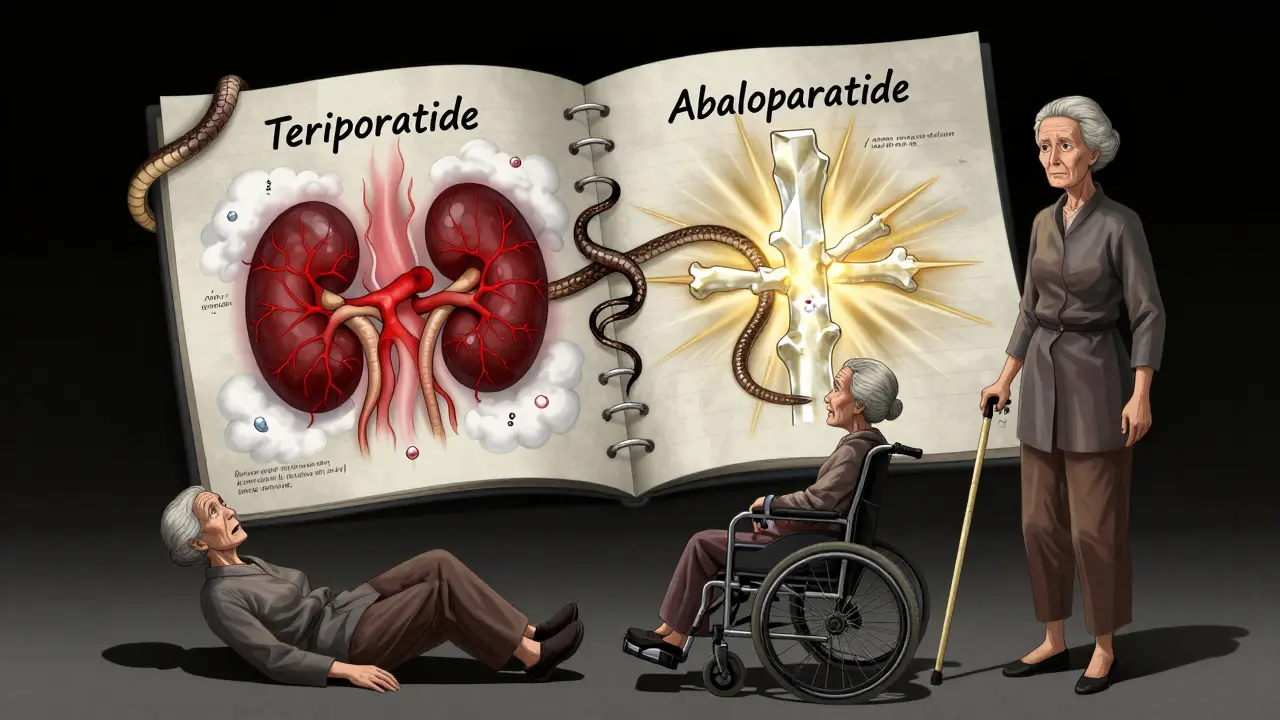
Both drugs mimic parts of your body’s natural bone-building signals. Teriparatide is a lab-made copy of the first 34 amino acids of parathyroid hormone (PTH). It’s been used since 2002. Abaloparatide is newer, made to look more like PTH-related protein (PTHrP), which your body uses during pregnancy to help build baby bones. The key difference? Abaloparatide binds more selectively to one version of the PTH receptor on bone cells. This means it turns on bone formation more strongly while accidentally triggering bone breakdown less often. That’s why studies show it causes less high calcium in the blood-hypercalcemia-than teriparatide.
In the ACTIVE trial, which followed over 2,400 postmenopausal women with osteoporosis for 18 months, abaloparatide reduced new spinal fractures by 86% compared to placebo. Teriparatide cut them by about 65%. That’s not a small gap. For someone who already broke a bone, that extra protection matters.
Which drug builds bone better?
Bone mineral density (BMD) is the easiest way to measure if a drug is working. Both drugs raise BMD, but not equally.
- At 18 months, abaloparatide increased total hip BMD by 3.41%. Teriparatide? Only 2.04%. That’s a 1.37% difference-statistically huge.
- For the femoral neck (the part of the hip most likely to break), abaloparatide led to a 2.93% gain. Teriparatide: 1.49%.
- At the spine, both did well, but abaloparatide pulled ahead early. By 6 months, it had boosted spine BMD by 6.58% versus teriparatide’s 5.25%.
That’s not just numbers. A 2025 analysis found that over half of women starting with a total hip T-score as low as -2.7 reached a safer level above -2.5 after 18 months on either drug. But if your hip is already in danger, abaloparatide gets you there faster and more reliably.
Fracture risk: The real bottom line
Bone density doesn’t always tell the full story. What matters is whether you break a bone. And here’s where abaloparatide pulls ahead.
A 2024 study of over 43,000 women found:
- 1.1% of those on abaloparatide broke a hip within 18 months. For teriparatide? 1.4%.
- Nonvertebral fractures (like wrists or ribs) dropped to 4.4% with abaloparatide versus 5.0% with teriparatide.
That might sound small, but for a 75-year-old woman, a hip fracture means a 20% chance of dying within a year. Even a 0.3% reduction in risk can mean the difference between living independently and needing long-term care.
And it’s not just the drugs themselves. When followed by alendronate (a common antiresorptive), abaloparatide’s benefits lasted. In the ACTIVE-EXTEND trial, patients who switched to alendronate after 18 months of abaloparatide had less than half the vertebral fracture rate of those who started on alendronate alone.
Safety: Why hypercalcemia matters more than you think
Teriparatide is known to raise blood calcium levels. In trials, 6.4% of users had hypercalcemia. For abaloparatide? Only 3.4%. That’s nearly half the rate.
Why does this matter? High calcium doesn’t just cause nausea or confusion. It can lead to kidney stones, dehydration, or even heart rhythm problems. Many patients stop teriparatide because of this. One Reddit user wrote: “Switched from teriparatide to abaloparatide after persistent hypercalcemia; calcium levels normalized within 3 months while maintaining BMD gains.”
Side effects like dizziness and injection site reactions are also lower with abaloparatide. A 2023 survey of 412 users showed 41% of teriparatide users felt dizzy versus 29% on abaloparatide. That’s not just discomfort-it’s a fall risk.
Cost and access: The hidden battle
Here’s the catch: abaloparatide costs more. As of mid-2024, monthly prices were $5,750 for abaloparatide and $4,200 for teriparatide. That’s a 37% difference. And while teriparatide became generic in January 2024, bringing its price down by nearly 40% by 2025, abaloparatide is still under patent.
Insurance coverage is tougher for abaloparatide. A 2023 analysis found 44% of users had trouble getting it covered, compared to 28% for teriparatide. Some patients delay starting treatment-or drop out-because of cost.
And yes, cost matters. Dr. Ethel Siris of Columbia University pointed out in 2019 that the absolute fracture risk reduction between the two drugs is small. “Does the 30% higher cost justify it?” she asked. For some, the answer is no. For others-especially those with prior fractures or very low hip density-the answer is yes.
Who gets which drug? Guidelines are clear
Professional guidelines don’t leave this to guesswork.
The American Association of Clinical Endocrinologists (AACE) 2023 guidelines say:
- Start with teriparatide if cost is a concern or if you’re at high risk for spinal fractures.
- Choose abaloparatide if your hip T-score is -3.0 or lower, or if you’ve already had a nonvertebral fracture.
Dr. Benjamin Leder, who led the ACTIVE trial, puts it simply: “Abaloparatide’s selective action means better hip bone gains with less bone loss. That’s why it’s preferred for hip osteoporosis.”
And while teriparatide has more real-world data because it’s been used for over 20 years, abaloparatide’s data is now just as solid. The ACTIVE-EXTEND 5-year follow-up confirmed its long-term fracture protection.
How you take it-and what to expect
Both drugs come in pre-filled pens. You inject yourself once a day, under the skin of your thigh or belly. You need to store them in the fridge. Most people get used to it within a few weeks, but the first month is rough for many.
Specialty pharmacies report that 78% of patients need help adjusting to the routine. Common issues:
- Forgetting to refrigerate the pen
- Injection timing (best taken at the same time each day)
- Transient dizziness after injection (sit down for 30 minutes)
Doctors recommend a DXA scan at 6 and 18 months. If your spine BMD hasn’t gone up by at least 3% by month 6, your doctor may question if the drug is working-or if you’re not taking it right.
What’s next? The future of bone-building drugs
Abaloparatide isn’t done evolving. Radius Health is testing a weekly version. If it works, adherence will jump. Right now, 32% of teriparatide users quit within a year. Only 24% of abaloparatide users do. A weekly shot could bring that down even further.
Also, the FDA is pushing for longer treatment durations. Right now, you’re limited to 18-24 months. After that, you switch to a drug like alendronate or denosumab to hold the gains. But what if you could stay on an anabolic longer? Trials are exploring that now.
By 2028, experts predict sequential therapy-starting with an anabolic, then switching to an antiresorptive-will be standard for severe osteoporosis. That’s because it works better than either drug alone.
Bottom line: It’s not about which drug is better. It’s about which drug is better for you.
Teriparatide is the proven, cheaper option. It builds bone. It reduces fractures. It’s been used by millions.
Abaloparatide is the smarter, more targeted option. It builds hip bone faster. It causes fewer side effects. It’s more effective at preventing nonvertebral fractures.
If you’re young, have good insurance, and your hip is in danger-abaloparatide might be worth the extra cost.
If you’re on a tight budget, have mostly spinal issues, and your doctor wants to start simple-teriparatide is still a powerful, reliable tool.
Neither is a magic bullet. Both require daily effort. Both work best when paired with calcium, vitamin D, weight-bearing exercise, and fall prevention. But if you’ve been told you need an anabolic agent, don’t just accept the first one offered. Ask: Which one is right for my bones, my body, and my life?
Can I take teriparatide or abaloparatide if I’ve had radiation therapy to my spine?
No. Both drugs carry a black box warning from the FDA against use in people with a history of radiation therapy to the skeleton, bone cancer, or Paget’s disease. These conditions increase the risk of osteosarcoma, a rare bone cancer. Even if your radiation was years ago, your doctor will check your medical history before prescribing either drug.
How long do I need to take teriparatide or abaloparatide?
The maximum approved duration is 24 months total in your lifetime. Most doctors prescribe 12 to 18 months, then switch you to an antiresorptive like alendronate or denosumab. This is called sequential therapy. Staying on an anabolic longer than 2 years doesn’t give more benefit and may increase cancer risk. Your doctor will monitor your bone density and adjust your plan accordingly.
Can I use these drugs if I’m still menstruating?
No. These drugs are only approved for postmenopausal women and men with osteoporosis. They’re not safe or effective in premenopausal women or people under 18. If you’re younger and have osteoporosis, your doctor will look for underlying causes-like hormonal imbalances, eating disorders, or steroid use-and treat those first.
What happens if I miss a dose?
If you miss a dose, take it as soon as you remember on the same day. If it’s already the next day, skip the missed dose and go back to your regular schedule. Don’t double up. Missing one dose won’t ruin your results, but consistency matters. Studies show patients who take at least 80% of their doses have significantly better bone density gains than those who skip frequently.
Do I still need calcium and vitamin D while on these drugs?
Absolutely. These drugs build bone, but they need the raw materials. You need at least 1,200 mg of calcium and 800-1,000 IU of vitamin D daily. If your levels are low, the drugs won’t work as well. Your doctor will check your blood levels early in treatment and adjust supplements as needed. Low vitamin D is one of the most common reasons anabolic therapy seems to “fail.”
Samar Khan
December 28, 2025 AT 20:16Russell Thomas
December 28, 2025 AT 21:23Joe Kwon
December 29, 2025 AT 22:19Nicole K.
December 30, 2025 AT 15:25Fabian Riewe
January 1, 2026 AT 10:24Amy Cannon
January 1, 2026 AT 17:05Himanshu Singh
January 2, 2026 AT 16:31Jasmine Yule
January 4, 2026 AT 08:02Greg Quinn
January 5, 2026 AT 05:09Lisa Dore
January 6, 2026 AT 09:55Sharleen Luciano
January 7, 2026 AT 09:53Jim Rice
January 7, 2026 AT 13:30Henriette Barrows
January 9, 2026 AT 01:02Alex Ronald
January 9, 2026 AT 13:58Teresa Rodriguez leon
January 11, 2026 AT 12:57