

For years, managing type 2 diabetes meant focusing on one thing: lowering blood sugar. But today, the game has changed. A new class of drugs called SGLT2 inhibitors isn’t just helping people control their glucose-it’s saving hearts and protecting kidneys in ways no other diabetes medication has. These aren’t just pills for blood sugar. They’re turning the tide on complications that once felt inevitable.
How SGLT2 Inhibitors Actually Work
Unlike insulin or metformin, SGLT2 inhibitors don’t touch insulin production or sensitivity. Instead, they work right in your kidneys. Every day, your kidneys filter about 180 liters of blood. Normally, almost all the glucose in that fluid gets reabsorbed back into your bloodstream. That’s thanks to a protein called SGLT2, which acts like a glucose sponge in the kidney’s tubules.
SGLT2 inhibitors block that sponge. When you take a drug like empagliflozin (Jardiance) or dapagliflozin (Farxiga), your kidneys stop reabsorbing so much glucose. The extra sugar? It gets flushed out in your urine. That’s why you might notice more trips to the bathroom-sometimes even a sweet smell. It’s not a side effect. It’s the mechanism.
This approach lowers blood sugar without risking low blood sugar (hypoglycemia). That’s huge. Most other diabetes drugs, like sulfonylureas, can drop glucose too far, causing dizziness, confusion, or even fainting. SGLT2 inhibitors? They’re self-limiting. Your body only excretes glucose when it’s above a certain level. No sugar? No effect.
The Heart Benefits You Can’t Ignore
In 2015, the EMPA-REG OUTCOME trial changed everything. Researchers gave empagliflozin to over 7,000 people with type 2 diabetes and existing heart disease. After three years, those on the drug had a 38% lower risk of dying from heart-related causes. That’s not a small number. It’s one of the biggest drops in cardiovascular death ever seen in a diabetes trial.
Why does this happen? It’s not just about glucose. These drugs reduce fluid overload, lower blood pressure, and improve how the heart muscle uses energy. They shift the heart’s fuel source toward ketones-more efficient, less stressful. In the DAPA-HF trial, even people without diabetes who had heart failure saw a 26% drop in hospitalizations when given dapagliflozin. The American Heart Association now says: if you have heart failure, you should be on an SGLT2 inhibitor-even if you don’t have diabetes.
Real-world stories back this up. One patient in Melbourne, 68, with type 2 diabetes and an ejection fraction of 28%, started on Farxiga. Six months later, his EF was 37%. His cardiologist called it "unusual"-but not surprising. That’s the pattern now. These drugs don’t just slow decline. They reverse it.
Kidney Protection: Slowing the Silent Killer
Diabetic kidney disease is the leading cause of dialysis in Australia. One in three people with type 2 diabetes will develop it. And once it starts, it’s hard to stop.
The CREDENCE trial in 2019 gave canagliflozin to over 4,400 people with diabetic kidney disease. After two years, the risk of kidney failure, doubling of creatinine, or death from kidney causes dropped by 30%. That’s the same level of protection you’d expect from a blood pressure drug-but this was just from lowering glucose excretion.
Even more striking? The EMPA-KIDNEY trial in 2023 showed empagliflozin reduced major kidney events by 28% in people with and without diabetes. That means the benefit isn’t just for diabetics. It’s for anyone with declining kidney function. The European Society of Cardiology now recommends these drugs for chronic kidney disease, regardless of diabetes status.
Doctors used to worry about kidney damage from these drugs. Early on, some patients saw a small dip in eGFR. But that’s not damage-it’s the kidneys adjusting. Think of it like lowering pressure in a leaking pipe. The initial drop stabilizes, and long-term function improves. It’s not a side effect. It’s a sign the drug is working.
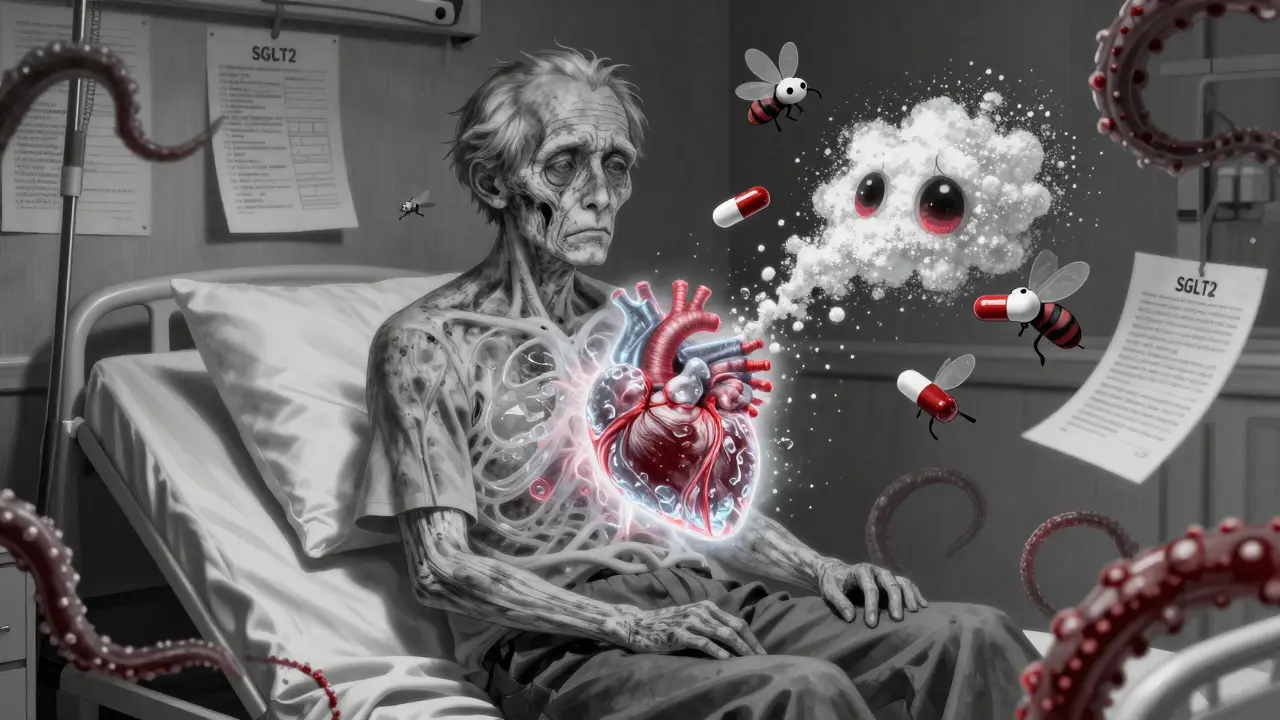
What You Gain Beyond Glucose
These drugs come with side effects you’ll actually welcome:
- Weight loss: On average, 2-3 kg over six months. No dieting needed.
- Blood pressure drop: Systolic pressure falls by 3-5 mmHg. That’s like adding a daily walk.
- More energy: Over two-thirds of users report feeling less fatigued. Less sugar spikes, less crashes.
It’s not magic. It’s physics. When you flush out 60-80 grams of glucose a day (about 240 calories), your body has to burn fat for energy. Weight loss follows. Lower blood volume from increased urination? Lower pressure. Simple. Direct. Effective.
The Downsides: What You Need to Watch For
Nothing is perfect. And these drugs aren’t risk-free.
The biggest concern is diabetic ketoacidosis (DKA). It’s rare-about 0.15% of users-but it can happen even when blood sugar isn’t high. This is called euglycemic DKA. Symptoms: nausea, vomiting, abdominal pain, confusion. If you’re sick, stressed, or preparing for surgery, talk to your doctor. You may need to pause the drug temporarily.
Genital yeast infections are common, especially in women. About 4-5% of users get them. It’s not dangerous, but it’s annoying. Good hygiene and keeping dry help. Men can get it too-less often, but still possible.
One drug, canagliflozin, showed a slightly higher risk of lower-limb amputations in the CANVAS trial. It’s rare-6.3 per 1,000 patients vs. 3.4 on placebo-but enough that doctors now avoid it in people with foot ulcers, poor circulation, or prior amputations. Other SGLT2 inhibitors don’t carry this signal.
Dehydration is another risk, especially in older adults or those on diuretics. Start with a lower dose. Drink water. Monitor your urine color. Pale yellow? You’re good. Dark? You need fluids.

Who Should Take Them? Who Should Avoid Them?
These drugs are now first-line for people with:
- Type 2 diabetes + heart disease
- Type 2 diabetes + heart failure
- Type 2 diabetes + chronic kidney disease (eGFR >30)
- Chronic kidney disease without diabetes (new evidence)
They’re not for everyone:
- Not for type 1 diabetes
- Avoid if eGFR is below 30 mL/min/1.73m²
- Use caution if you’re elderly, on diuretics, or have low blood pressure
- Don’t use if you’ve had repeated genital infections that didn’t respond to treatment
Cost is still a barrier. In Australia, these drugs cost $40-$50 per month with a PBS subsidy. Without it, they’re over $600. Insurance coverage varies. If your doctor prescribes one, ask about patient support programs. Many manufacturers offer co-pay assistance.
What’s Next? The Future of SGLT2 Inhibitors
The research is accelerating. Trials are now testing these drugs in prediabetes, obesity without diabetes, and even non-diabetic heart failure. The DELIVER trial showed dapagliflozin helps people with HFpEF-heart failure where the heart pumps normally but doesn’t relax well. That’s a huge group-half of all heart failure patients.
Generic versions are coming. Patents for Jardiance and Farxiga expire between 2025 and 2028. Once they do, prices could drop 60-70%. That’s when these drugs will move from specialty therapy to standard care.
The American Diabetes Association’s 2024 guidelines are expected to expand recommendations even further. We’re moving toward a new model: treat the whole person, not just the glucose. SGLT2 inhibitors are the first class of diabetes drugs that do exactly that.
Final Thoughts: A New Standard of Care
If you have type 2 diabetes and heart or kidney disease, you’re not just managing a condition-you’re fighting for your life. SGLT2 inhibitors give you a real shot at living longer, feeling better, and avoiding dialysis or heart failure hospitalizations. They’re not perfect. But they’re the best thing we’ve had in decades.
Ask your doctor: "Am I a candidate?" If you’re on metformin alone, it might be time to add one. If you’re on insulin and still struggling, this could be the missing piece. Talk about your kidneys. Talk about your heart. This isn’t just about sugar anymore. It’s about survival.
Do SGLT2 inhibitors cause weight loss?
Yes. On average, people lose 2-3 kg (4-7 lbs) over six months. This happens because the drugs cause the body to excrete 60-80 grams of glucose daily-roughly 240 calories. The body then burns fat for energy, leading to gradual weight loss without dieting or increased exercise.
Can SGLT2 inhibitors be used if you don’t have diabetes?
Yes. In 2021, the FDA approved dapagliflozin for heart failure regardless of diabetes status. In 2023, the EMPA-KIDNEY trial confirmed empagliflozin reduces kidney decline even in non-diabetic chronic kidney disease. Guidelines now support their use for heart failure and kidney protection beyond type 2 diabetes.
Why do SGLT2 inhibitors increase the risk of yeast infections?
The drugs cause glucose to spill into urine, creating a sugary environment in the genital area. Yeast thrives on sugar. This leads to infections like vulvovaginal candidiasis in women and balanitis in men. Good hygiene, drying after urination, and avoiding tight clothing can reduce risk. Most cases respond to over-the-counter antifungal treatments.
Are SGLT2 inhibitors safe for older adults?
Generally yes, but with caution. Older adults are more prone to dehydration and low blood pressure due to reduced kidney function and medication interactions. Doctors often start with a lower dose and monitor fluid intake and blood pressure closely. Avoid use in those with frequent falls, severe mobility issues, or on multiple diuretics.
What’s the difference between Jardiance, Farxiga, and Invokana?
All three are SGLT2 inhibitors and work similarly. Jardiance (empagliflozin) has the strongest evidence for heart failure and cardiovascular death reduction. Farxiga (dapagliflozin) has the broadest kidney and heart failure data, including non-diabetic patients. Invokana (canagliflozin) shows the most weight loss and blood pressure reduction but carries a slightly higher amputation risk. Choice depends on your health profile and doctor’s recommendation.
tia novialiswati
February 26, 2026 AT 15:51OMG this is LIFE-CHANGING info!! 🙌 I started on Jardiance 6 months ago and my A1C dropped from 8.2 to 5.9, AND I lost 15 lbs without even trying! My cardiologist said my heart function improved too. Who knew peeing out sugar could be this awesome?? 😍
Lillian Knezek
February 27, 2026 AT 05:56They’re hiding the truth. These drugs are just a gateway to Big Pharma’s real agenda: turning diabetics into lab rats. Ever wonder why the FDA approved them so fast? The same people who pushed COVID vaccines are behind this. 🤔
Christopher Brown
February 27, 2026 AT 20:11Pathetic. You people act like this is some miracle drug. It’s just a glorified diuretic with a fancy name. If you can’t control your diet, stop blaming the medicine. I’ve seen 70-year-olds on this stuff still eating donuts. Wake up.
Sanjaykumar Rabari
March 1, 2026 AT 09:05This is not medicine. This is poison. My cousin in Mumbai took this and got sick. Doctors said nothing. Now he is in hospital. Why do they allow this? Big Pharma wants to kill poor people. They do not care. This is war.
Kenzie Goode
March 3, 2026 AT 08:46I’m crying. Not because I’m sad, but because I finally feel like I’m not just surviving with diabetes-I’m living. I used to dread mornings because of the fatigue. Now I walk my dog, I cook, I laugh. This isn’t just a drug. It’s a second chance. Thank you to every researcher who believed in this.
Dominic Punch
March 3, 2026 AT 13:20For anyone new to SGLT2 inhibitors: start low, go slow. Hydrate like your life depends on it-because it kinda does. I’ve helped 12 patients switch from metformin to Farxiga. Every single one had better energy, better BP, and fewer lows. This isn’t magic. It’s science done right. You got this.
Joanna Reyes
March 4, 2026 AT 12:41I’ve been on empagliflozin for 18 months now, and honestly? It’s been the most transformative thing in my health journey. My eGFR dipped a bit at first-I panicked, called my nephrologist, they said it was normal. Six months later, it stabilized and then crept up. My kidney function is better than it’s been in 10 years. And the weight loss? I didn’t even realize I was losing until my pants started falling off. It’s not about willpower. It’s about biology. The body knows what to do when you give it the right signal. This isn’t just treating diabetes. It’s retraining the whole system. I wish I’d known about this five years ago. My heart would’ve been stronger. My kidneys would’ve been spared. I’m not saying it’s perfect. But it’s the closest thing we’ve had to a reset button for metabolic disease.
Stephen Archbold
March 5, 2026 AT 18:01Hey just wanted to say I started this after my heart attack last year and wow. I’m not gonna lie-I was scared. But my doc said it was the best thing for me. I lost 8kg, my BP is normal now, and I’m sleeping better. Also-yeast infection? Yeah, it happened. But I just used Monistat and it’s fine. Don’t let fear stop you. Talk to your doc. You’re not alone.
Nerina Devi
March 7, 2026 AT 13:20In India, these drugs are still out of reach for most. But I’ve seen patients on generics-canagliflozin from local labs-and they’re doing better than with older meds. The real issue isn’t the science. It’s access. We need to push for cheaper versions. No one should die because they can’t afford to live. Let’s make this a global health priority, not a luxury.
Timothy Haroutunian
March 9, 2026 AT 07:58Ugh. Another article acting like this is the holy grail. What about the 15% of people who get DKA? Or the ones who lose limbs? Or the fact that these drugs don’t fix insulin resistance? They just mask it. And now we’re telling people to take them for heart failure? What’s next? Prescribing aspirin for cancer? This is all just trend-chasing under the guise of science.
Erin Pinheiro
March 9, 2026 AT 12:56OMG I just realized-this whole thing is a scam. They’re telling us to pee out sugar like it’s a virtue? Like we’re not supposed to eat carbs? So why is the FDA letting sugar companies sponsor conferences? And why is the ADA pushing this? It’s all connected. Big Pharma + Big Sugar. Wake up, sheeple. 🤡
Michael FItzpatrick
March 11, 2026 AT 05:11Think of SGLT2 inhibitors like a pressure release valve on a steam engine. The body’s overloaded with glucose, and instead of blowing up, it vents. That’s not a side effect-that’s a system upgrade. You’re not just lowering sugar. You’re giving your heart, kidneys, and pancreas a breather. It’s like hitting pause on metabolic chaos. And yeah, the yeast thing? Annoying. But way better than dialysis.
Brandice Valentino
March 11, 2026 AT 14:11So… you’re telling me I can lose weight and not even diet? And I get to pee out my dessert? That’s basically a cheat code. I’m so done with counting calories. This is the future. I’m telling all my friends. Also, I got a yeast infection. It’s fine. Worth it. 🤷♀️
Larry Zerpa
March 12, 2026 AT 13:58Let’s be real: every study on SGLT2 inhibitors is funded by pharmaceutical companies. The ‘38% reduction in heart death’? That’s a relative risk. Absolute risk? 1.5% vs 2.4%. That’s not a breakthrough-it’s a marketing win. And don’t get me started on the ‘kidney protection’ claims. The eGFR dip? That’s not adaptation. That’s nephrotoxicity in disguise. We’re treating biomarkers, not patients. This isn’t medicine. It’s a numbers game.