

When you pick up a prescription, you might not realize the pill in your hand could be the exact same as the brand-name drug-just with a different label. That’s an authorized generic. Unlike regular generics, which are made by different companies and may have different fillers or coatings, authorized generics come from the same manufacturer as the brand-name drug, using the same formula, same ingredients, same factory. They’re identical in every way except the box and the name.
For patients, this matters. If you’ve ever switched from a brand to a generic and noticed a change-mild nausea, dizziness, or just feeling "off"-it might not be your condition. It could be the inactive ingredients. Authorized generics avoid that entirely. They’re not just "close enough." They’re the same drug you’ve been taking, just cheaper.
What Exactly Is an Authorized Generic?
The FDA defines an authorized generic as a brand-name drug that’s sold under a different label, usually by the original manufacturer or an affiliate. It’s not a copy. It’s the real thing, repackaged. No new clinical trials. No bioequivalence studies. Just a different sticker on the bottle.
Take Lyrica (pregabalin), for example. The brand version costs over $200 a month without insurance. The authorized generic? Around $180. Not a huge drop, but if you’re on a fixed income, every dollar counts. And because it’s the exact same formulation, your doctor doesn’t have to worry about switching you. No risk of reduced effectiveness. No hidden variables.
Compare that to a regular generic. It might be $20. But if it’s made by a different company, the inactive ingredients can vary. One batch might use cornstarch. Another might use lactose. For people with sensitivities, that’s a problem. Authorized generics remove that uncertainty.
Why Are There So Few New Authorized Generics?
Here’s the twist: the number of new authorized generics has dropped sharply. In 2022, the FDA approved 37. In 2025, it was just 12. Why? Because regulators are cracking down.
Brand-name companies used to launch authorized generics as a tactic to block cheaper competitors. They’d release their own version at a slightly lower price, making it hard for true generics to gain traction. This is called "product hopping." The FTC called it anti-competitive. In 2023, Teva paid $1.2 billion to settle allegations over its authorized generic of Copaxone.
Since then, companies have pulled back. Why risk a lawsuit when you can wait for biosimilars? Take Stelara (ustekinumab). In 2025, five biosimilars hit the market-Otulfi, Selarsdi, Yesintek, Pyzchiva, and one more. These are different drugs, made from living cells, but they mimic the brand. And because they’re classified as biosimilars, they’re not subject to the same FTC scrutiny as authorized generics.
So now, brand companies are shifting strategy. They’re not fighting generics. They’re skipping them entirely and going straight to biosimilars.
What Authorized Generics Are Available Right Now?
As of October 2025, the FDA lists 1,247 authorized generics. The most common are for heart conditions, mental health, and diabetes. Here are two recent additions:
- Xyrem (sodium oxybate) - Now available as an authorized generic from Jazz Pharmaceuticals. Used for narcolepsy. The brand version costs over $10,000 a year. The authorized version is about $7,500.
- Trulance (plecanatide) - Approved for chronic constipation. Ironwood Pharmaceuticals now sells it under a different label. Price dropped from $1,200 to $900 per month.
These aren’t big-name drugs with millions of users. But for the people who need them, the difference is real.
And yes, some older ones are still around. The authorized generic of sertraline (Zoloft) is still widely used. Many patients report no side effects on it, unlike some traditional generics that caused headaches or GI issues.
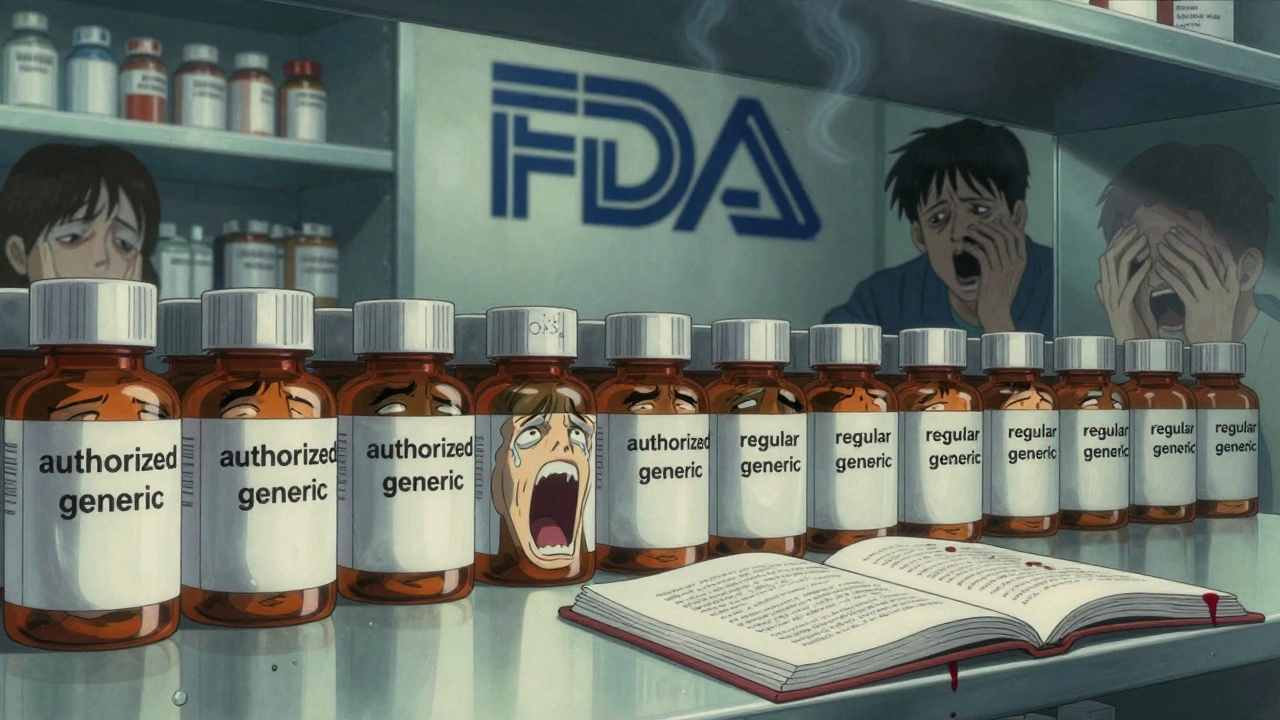
Why Don’t More Pharmacies Stock Them?
Here’s the catch: even if an authorized generic exists, your pharmacy might not carry it. Why? Because insurance companies and pharmacy benefit managers (PBMs) don’t always push for them.
Most PBMs make money from rebates. They negotiate lower prices with generic manufacturers in exchange for exclusive placement on their formularies. Authorized generics don’t offer big rebates-they’re too close in price to the brand. So PBMs often drop them.
One Reddit user, u/HealthPlanInsider, shared that Blue Cross Blue Shield removed coverage for the authorized generic of Jardiance (empagliflozin). The patient had to go back to the brand, even though the authorized version was chemically identical. Why? Because the PBM got a better deal on the regular generic.
Pharmacists, too, struggle to identify them. A 2025 survey found 63% of pharmacists couldn’t tell an authorized generic from a regular one without checking the FDA’s Orange Book. That means patients often get counseling they don’t need-or worse, they’re switched to a regular generic without realizing the difference.
Are Authorized Generics Worth It?
It depends on your situation.
If you’re on a drug with a narrow therapeutic index-like warfarin, levothyroxine, or seizure meds-authorized generics are the safest bet. Even tiny differences in absorption can cause serious issues. A 2024 JAMA study showed patients on authorized generics were 40% less likely to have a medication-related hospital visit than those on traditional generics.
If you’re on a drug like sertraline or metformin, and you’ve had no issues with generics, then the cheapest option might be fine. But if you’ve ever had a bad reaction to a generic, ask your doctor about the authorized version.
Cost-wise, authorized generics are usually 10-15% cheaper than the brand. That’s not the 80% discount you get with regular generics. But for people with high-deductible plans or no insurance, even a small drop can make a difference.
And here’s something few people know: some manufacturers quietly make authorized generics without advertising them. You won’t see ads. You won’t find them on GoodRx’s top 10 list. You have to ask.
How to Find an Authorized Generic for Your Prescription
It’s not easy, but it’s possible.
- Check the FDA’s Authorized Generics List (search by brand name).
- Ask your pharmacist: "Is there an authorized generic for this drug?" Don’t accept "I don’t know." Push for a lookup.
- Call the manufacturer of the brand-name drug. Many have patient assistance lines that can tell you if they make an authorized version.
- If you’re on Medicare or private insurance, ask your plan if they cover authorized generics. Some do, but only if you request it.
Pro tip: If your doctor writes "dispense as written" on the prescription, you can’t be switched to a different generic without their approval. That’s your leverage.
The Future of Authorized Generics
The writing’s on the wall. The FDA’s 2025 report shows authorized generics now make up just 7% of all generic drugs. By 2027, that could drop below 5%.
Why? Two big reasons:
- Regulation: The FTC is still watching. Any move that looks like blocking competition gets fined.
- Legislation: The RELIEF Act, introduced in May 2025, would force authorized generics to match the price of traditional generics. If it passes, brand companies will have no reason to make them.
But experts like Dr. Aaron Kesselheim at Harvard say they’re still vital. "For patients who need absolute consistency-especially with chronic conditions-authorized generics are a safety net," he says.
They’re not the future of generics. But for now, they’re the most reliable option when you can’t afford to risk a formulation change.
If you’re taking a drug that’s critical to your health, don’t assume the cheapest generic is the best. Ask. Look. Push for the version that’s truly identical to what you’ve always known.
Because sometimes, the best medicine isn’t the cheapest. It’s the one you know won’t change on you.
nikki yamashita
December 13, 2025 AT 02:56Just got my authorized generic for sertraline last week-no more headaches, no nausea, just steady. Why didn’t anyone tell me this sooner?
sandeep sanigarapu
December 14, 2025 AT 21:57In India, we rarely see authorized generics. Even if available, pharmacies rarely stock them due to pricing structures. Patients are forced to choose between cost and consistency-this is a global issue.
Donna Anderson
December 15, 2025 AT 06:26omg i just found out my zoloft is an authorized generic?? i thought i was just lucky lol. no more brain fog. thank you for this post!!
Nathan Fatal
December 16, 2025 AT 19:10The real problem isn’t the lack of authorized generics-it’s the systemic incentive misalignment. PBMs profit from rebates on traditional generics, not from patient outcomes. The system rewards cost-cutting, not clinical fidelity. Until that changes, patients will keep paying the price in side effects and hospital visits.
Laura Weemering
December 17, 2025 AT 18:16It’s not just about the drug-it’s about control. You’ve been on the same brand for years, and suddenly, without warning, your body is reacting to a new filler, a new coating, a new... existential uncertainty. The authorized generic isn’t cheaper-it’s *predictable*. And in chronic illness, predictability is the only luxury we get. The FDA doesn’t regulate emotional stability, but it should. We’re not just taking pills-we’re taking chances. Every. Single. Time.
Rob Purvis
December 18, 2025 AT 17:12Wait-so if PBMs are pushing cheaper generics because of rebates, and pharmacists can’t even tell the difference... then who’s actually looking out for the patient? Is this a failure of regulation, or a failure of transparency? The Orange Book is useless if no one’s trained to use it. And if doctors aren’t educated on this, then how are patients supposed to know to ask?
Reshma Sinha
December 19, 2025 AT 12:35Authorized generics are the silent heroes of pharmacotherapy. They’re the bridge between brand-name assurance and generic affordability. Yet they’re buried under rebate structures and institutional inertia. We need mandatory labeling-clear, bold, FDA-mandated text on the bottle: "Same formulation as brand. No inactive ingredient variation." That’s all it takes.
Levi Cooper
December 19, 2025 AT 20:41Why are we even talking about this? In America, we should be demanding real innovation-not playing pharmacy roulette with our health. If you can’t afford the brand, get help. Don’t settle for a generic that might as well be a placebo with a different label. This country’s healthcare system is broken-and we’re all just picking up the pieces.