
QT Interval Calculator
Calculate corrected QT interval using either the Bazett or Fridericia formula. This helps assess risk of dangerous heart rhythms when using antibiotics that prolong QT interval.
Input Parameters
Results
-- ms
Normal QTc interval indicates minimal risk of dangerous arrhythmias.
Note: Risk assessment is based on QTc alone. Consider additional factors like age, electrolyte levels, and other medications.
When a patient gets a urinary tract infection or a respiratory bug, doctors often reach for antibiotics like azithromycin or ciprofloxacin. But behind those common prescriptions lies a quiet, dangerous risk: QT prolongation. It’s not something most patients know about, but it can trigger a life-threatening heart rhythm called Torsades de Pointes. And the risk doesn’t come from one drug alone-it grows when fluoroquinolones and macrolides are used together, especially in older adults with other health problems.
What QT Prolongation Really Means
The QT interval on an ECG measures how long it takes the heart’s ventricles to recharge between beats. If that interval stretches too long, the heart can misfire. That’s QT prolongation. It doesn’t cause symptoms on its own, but it sets the stage for Torsades de Pointes-a chaotic, fast heart rhythm that can turn deadly in seconds. Fluoroquinolones like ciprofloxacin, levofloxacin, and moxifloxacin, and macrolides like erythromycin and azithromycin, both block a specific potassium channel in heart cells called hERG. This slows down repolarization. Think of it like a runner who can’t catch their breath after sprinting-the heart muscle stays electrically charged too long. The result? A higher chance of dangerous arrhythmias. This isn’t theoretical. In the 1990s, sparfloxacin was pulled from the market because too many patients developed fatal heart rhythms. Even today, over 17 documented cases link levofloxacin to Torsades de Pointes. And it’s not just rare outliers-critically ill patients in ICUs often have multiple risk factors stacking up at once: low potassium, kidney trouble, older age, and multiple QT-prolonging drugs. A 2021 study tracking ICU patients on IV ciprofloxacin and erythromycin found QT changes within hours of the first dose.Not All Antibiotics Are Created Equal
The risk isn’t the same across the board. Some fluoroquinolones are far more dangerous than others. Here’s the real hierarchy:- High risk: Moxifloxacin
- Low risk: Ciprofloxacin
- Minimal risk: Levofloxacin
- High risk: Erythromycin
- Medium risk: Clarithromycin
- Low risk: Azithromycin
How to Measure QT Correctly
You can’t just look at an ECG and guess. You need to calculate the corrected QT interval, or QTc. There are two formulas, and one is outdated. Bazett’s formula (QTc = QT / √RR) has been used for decades. But it overcorrects when the heart rate is fast and undercorrects when it’s slow. That means you might miss a real problem-or falsely flag a normal one. The Fridericia formula (QTc = QT / √RR³) is now the gold standard. It’s more accurate, especially for predicting death risk within 30 days. Studies show it reduces false positives and gives a clearer picture of true risk. And here’s a big gotcha: some heart conditions make QT look longer even when it’s not. Bundle branch blocks, paced rhythms, or a QRS complex longer than 140 ms can distort the reading. If you don’t account for these, you might stop a safe antibiotic unnecessarily.
Who Needs Monitoring-and When
Not every patient needs an ECG before taking these drugs. But some absolutely do. The British Thoracic Society guidelines (2023) say this clearly:- Before starting any macrolide: Do a baseline ECG. If QTc is over 450 ms in men or 470 ms in women, avoid the drug.
- One month after starting: Repeat the ECG. QT prolongation can develop slowly.
- Check ECG 7-15 days after starting.
- Repeat monthly for the first 3 months.
- Then, check periodically if the patient stays on the drug long-term.
High-Risk Patients: Who’s Most in Danger?
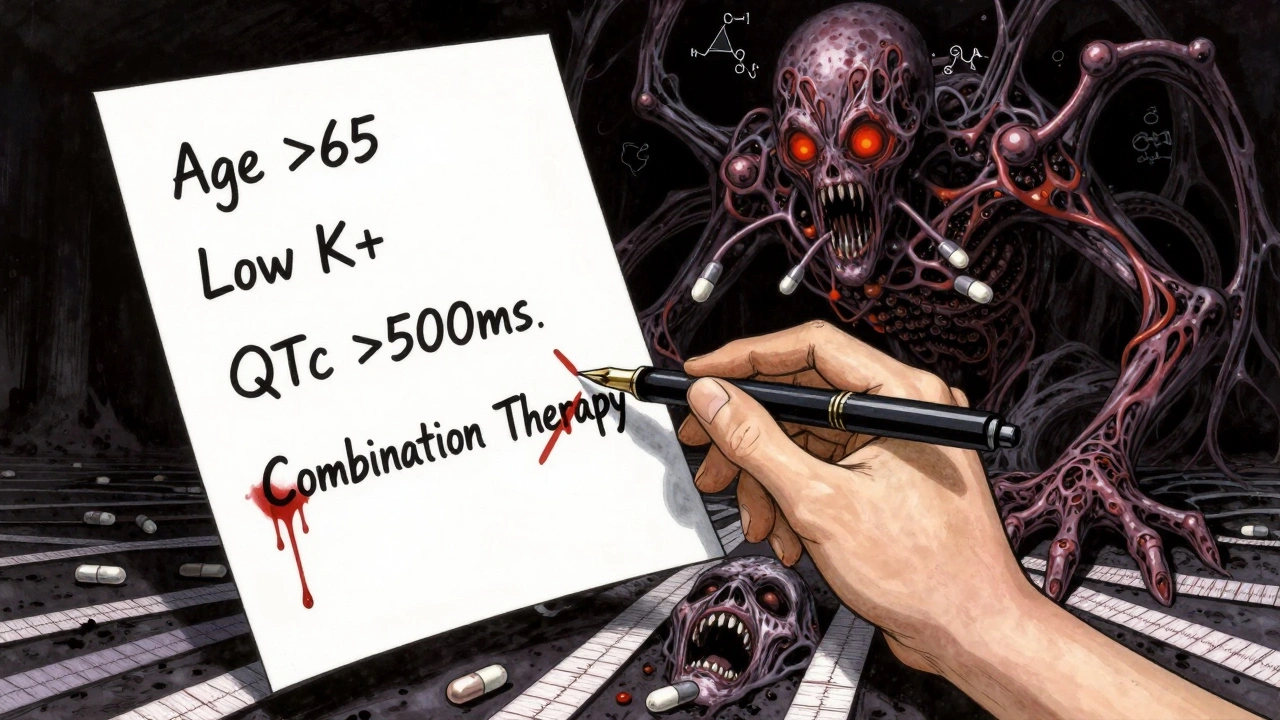
Some people are walking time bombs. Here’s who needs extra caution:- Women over 65
- Patients with low potassium (below 3.5 mmol/L) or low magnesium (below 1.7 mg/dL)
- Those with heart failure, past heart attack, or ejection fraction under 40%
- People taking other QT-prolonging drugs-antidepressants, antifungals, anti-nausea meds
- Patients with kidney or liver disease (these drugs aren’t cleared well)
- Anyone with a family history of long QT syndrome
What to Do If QT Prolongation Shows Up
If a follow-up ECG shows QTc over 500 ms-or if it’s increased by more than 60 ms from baseline-you stop the drug. Immediately. Don’t wait. Don’t reduce the dose. Don’t assume it’ll fix itself. Torsades de Pointes can strike without warning. While stopping the antibiotic is step one, you also need to fix the other triggers:- Give IV magnesium sulfate-even if the level is normal. It stabilizes heart cells.
- Correct potassium to above 4.0 mmol/L.
- Stop any other QT-prolonging meds if possible.
- Check thyroid function. Hypothyroidism can worsen the risk.
Why This Matters Beyond the Hospital
Most QT prolongation deaths happen outside the ICU. Older adults in nursing homes are being prescribed fluoroquinolones for simple UTIs-despite FDA warnings and guidelines that say not to. Why? Because it’s easy. A single pill. Fast relief. But the cost? A cardiac arrest on a Tuesday morning. A family scrambling to understand why. A death that could have been prevented with a simple ECG. Antibiotic stewardship isn’t just about fighting resistance. It’s about choosing the right drug for the right person. Azithromycin might be safer than erythromycin, but it’s not risk-free. Levofloxacin is better than moxifloxacin, but it’s still not harmless in high-risk patients. The answer isn’t to avoid these drugs entirely. It’s to use them wisely. Know your patient’s history. Check the ECG when needed. Correct the electrolytes. Avoid combinations. Document everything.What’s Next?
Research is moving fast. Tools are being developed to predict individual risk using AI-inputting age, gender, meds, labs, and ECG data to give a real-time risk score. Genetic testing for long QT mutations is becoming more accessible too. For now, the tools we have are simple: ECGs, the Fridericia formula, and a checklist of risk factors. Use them. Every time. This isn’t about fear. It’s about responsibility. These antibiotics save lives. But they can also end them-quietly, unexpectedly, and preventably.Can azithromycin cause QT prolongation?
Yes, but the risk is low compared to other macrolides like erythromycin or clarithromycin. Azithromycin has a weaker effect on the hERG potassium channel. Still, it can prolong QT in patients with multiple risk factors-like older age, low potassium, or kidney disease. Always check baseline ECG before prescribing, especially in high-risk groups.
Is ciprofloxacin safer than moxifloxacin for QT prolongation?
Yes. Ciprofloxacin carries a low risk of QT prolongation, while moxifloxacin is classified as high risk. Moxifloxacin is known to cause more significant QT prolongation and has been linked to more cases of Torsades de Pointes. For patients with any cardiac risk factors, ciprofloxacin is the preferred fluoroquinolone-when an antibiotic is even needed.
Should I always do an ECG before prescribing fluoroquinolones?
No, not for every patient. If someone is young, healthy, with no heart disease, no electrolyte imbalances, and not taking other QT-prolonging drugs, routine ECGs aren’t needed. But if they’re over 65, have kidney disease, are on diuretics, or have a history of arrhythmia-then yes. A baseline ECG before starting is critical.
What’s the best way to correct QT prolongation?
Stop the offending antibiotic immediately. Then give intravenous magnesium sulfate-even if serum levels are normal. Magnesium helps stabilize heart cell membranes. Also correct potassium to above 4.0 mmol/L and magnesium above 2.0 mg/dL. Avoid other QT-prolonging drugs. Continuous cardiac monitoring is needed until the QT interval returns to normal.
Can QT prolongation from antibiotics be reversed?
Yes, usually. Once the antibiotic is stopped and electrolytes are corrected, the QT interval often returns to normal within days. But the risk doesn’t disappear entirely. Re-exposing the patient to the same drug-even months later-can trigger arrhythmias again. Never restart the same antibiotic. Choose a safer alternative.
Eddy Kimani
December 1, 2025 AT 21:11Just read this and had to pause. The hERG channel blockade is such an underdiscussed mechanism in clinical practice. We’re prescribing these drugs like they’re vitamin C, but the electrophysiological cascade is terrifyingly precise. Moxifloxacin + azithromycin in a diabetic elderly woman on furosemide? That’s not a prescription-it’s a lottery ticket with a 1 in 500 chance of cardiac arrest. And nobody’s checking QTc properly. Bazett’s is still everywhere. We need to mandate Fridericia in EMRs. Period.
Genesis Rubi
December 2, 2025 AT 23:19why do we even use these drugs anymore? like wtf. azithromycin is fine for a cold but if you got a uti just give amoxicillin. its 2025 and we still act like we’re in 1998. doctors are lazy. and the FDA says dont do it but they still do. america is falling apart.
Doug Hawk
December 3, 2025 AT 08:52Biggest thing no one talks about is how often we miss the confounders. Bundle branch block? Paced rhythm? QRS >140ms? I’ve seen QTc flagged as 520 ms when the real issue was a left bundle branch. We’re overtreating and underthinking. And magnesium? Yeah give it even if serum’s normal. It’s not about correcting a deficit-it’s about membrane stabilization. That’s not magic, that’s pharmacology 101. Why isn’t this in every EMR alert?
John Morrow
December 4, 2025 AT 01:15Let’s be honest-this entire discussion is a product of overmedicalization and risk-averse culture masquerading as clinical wisdom. The absolute risk of Torsades from azithromycin in a healthy 60-year-old is statistically negligible-less than 1 in 10,000. But now we’re subjecting every UTI patient to baseline ECGs, delaying treatment, increasing costs, and creating false positives that lead to unnecessary anxiety and further testing. The data doesn’t support blanket monitoring. It supports targeted use. We’ve lost the art of clinical judgment in favor of algorithmic paranoia.
Kristen Yates
December 5, 2025 AT 10:44I work in a rural clinic. We don’t have ECG machines on site. We send patients to the county hospital. Sometimes they wait 3 days. If a patient has a UTI and a cough, we pick the safest antibiotic we can. Cipro is cheaper than moxi. Azithro is cheaper than clarithro. We do what we can with what we have. The guidelines are great. But they don’t help when the machine’s broken and the patient’s waiting in the parking lot.
Saurabh Tiwari
December 5, 2025 AT 11:14bro this is wild but also so true 😮💨 i had a cousin in delhi get azithro + cipro for a fever and ended up in ICU for 3 days. no one told his family anything about heart risks. just gave pills. we need to educate people too not just docs. 🙏
Michael Campbell
December 6, 2025 AT 06:05They’re hiding the truth. Big Pharma knows this kills people. They fund the studies that say it’s safe. The FDA’s asleep. Your doctor doesn’t care because he’s on quota. You think this is about health? No. It’s about profit. And you’re the product.
Saravanan Sathyanandha
December 6, 2025 AT 19:05While the pharmacological mechanisms are well documented, the real challenge lies in the implementation gap between evidence and practice. In resource-constrained settings, even basic ECG monitoring remains a luxury. The solution is not merely to issue guidelines but to embed decision-support tools into primary care workflows-preferably mobile-integrated, multilingual, and accessible offline. The science is clear. The infrastructure is not. We must bridge that divide with humility, not hubris.
alaa ismail
December 7, 2025 AT 04:32Been prescribing cipro for UTIs for years. Never checked QT. Now I’m gonna start. Just read this and realized I’ve been lucky. Not gonna be lucky forever. Thanks for the wake-up call.
Zoe Bray
December 8, 2025 AT 23:53It is imperative that clinicians recognize that the risk of QT prolongation is not merely a pharmacological artifact but a systemic failure of clinical vigilance. The Fridericia correction formula must be integrated into all electronic health record systems as the default QTc calculation algorithm. Furthermore, mandatory pre-prescription screening protocols for high-risk patients should be codified into institutional policy, with audit trails to ensure compliance. This is not optional-it is a standard of care.
Girish Padia
December 9, 2025 AT 11:36people dont care about heart health until its too late. you think your 70 year old grandma is safe because she takes her pills? she’s on diuretics, has diabetes, and now you give her cipro and azithro? what are you thinking? this is negligence. someone should get sued for this.