
Drug shortages aren’t accidents. They’re the result of fragile systems that haven’t been built to handle real-world shocks. When a single factory in India shuts down for a regulatory inspection, or a shipping container gets stuck in the Red Sea, millions of patients in the U.S. and Australia can’t get their heart medication, antibiotics, or insulin. It’s not a glitch-it’s a design flaw. And the fix isn’t just about ordering more pills. It’s about rebuilding the entire system from the ground up.
Why Global Supply Chains Are Falling Apart
For decades, pharmaceutical companies chased the cheapest way to make drugs. That meant outsourcing almost everything: active ingredients (APIs), packaging, even final assembly. Today, 80% of APIs come from overseas, mostly from China and India. That sounds efficient-until it doesn’t. In 2023, a heatwave in India disrupted production of a common blood pressure drug. Within weeks, U.S. hospitals were rationing doses. The same thing happened with antibiotics in 2024 when a Chinese facility lost power for three days. No one saw it coming. No one had a backup. The truth? Lean supply chains are great when nothing goes wrong. But when something does, they break fast. The FDA says only 28% of essential medicine APIs are made in the U.S. For sterile injectables-critical for ICUs-it’s just 12%. That’s not a supply issue. It’s a national risk. The Department of Defense calls it a national security threat. And they’re right. If a country wants to control access to life-saving drugs, all it has to do is cut off a few export routes.What Resilience Actually Looks Like
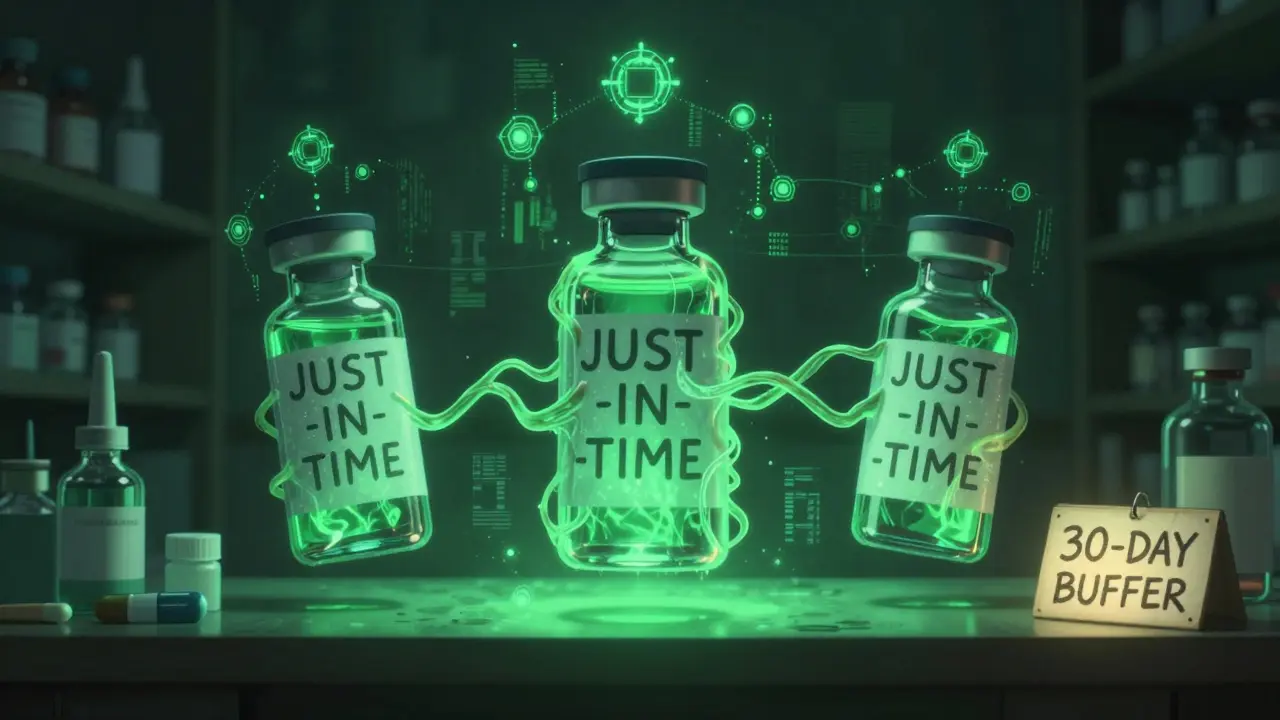
Resilience doesn’t mean bringing everything home. That’s impossible-and expensive. It means building flexibility. Three things make a supply chain resilient: preparation, response, and recovery. Preparation means knowing where your risks are. Top companies now map out 12 to 15 layers of suppliers. Not just the API maker, but the chemical supplier, the packaging vendor, the logistics partner. They ask: What if this factory floods? What if this port closes? What if this country imposes an export ban? Response means having options ready. The best companies dual-source 70-80% of their critical ingredients. If one supplier fails, another kicks in within days. They also keep 60 to 90 days of buffer stock for essential drugs-medications that can’t be delayed, like epinephrine or chemotherapy agents. That’s not waste. That’s insurance. Recovery means bouncing back fast. Companies using continuous manufacturing can restart production in weeks, not months. Traditional batch plants take 6-12 months to get back online after a shutdown. Continuous systems use smaller, modular units that can be swapped out like batteries. One facility in North Carolina now makes 200kg of API per month in a space the size of a garage. The old way would’ve needed a building the size of a football field.Technology Is the Game Changer
You can’t fix this with spreadsheets. You need real-time data. AI now predicts disruptions 60 to 90 days in advance by analyzing weather patterns, political unrest, shipping delays, and even social media chatter about factory closures. One U.S. company started using AI to track port congestion in Mumbai. When it flagged a 70% chance of delay in February, they rerouted a shipment from Chennai instead. Saved 14 days. Kept 1.2 million doses on shelves. Blockchain is another quiet hero. It tracks every pill from raw chemical to pharmacy shelf. In pilot programs, it cut counterfeit drugs by 75%. That’s not just about fraud-it’s about trust. If a hospital knows exactly where a drug came from, they’re less likely to panic during a shortage. And then there’s continuous manufacturing. It’s not sci-fi. The FDA has approved 12 facilities using it as of mid-2025. These plants use 25% less energy, waste 20% less material, and produce drugs 30% faster than old batch methods. The catch? They cost $50 million to $150 million to build. That’s why only big companies can afford them. But for critical drugs-like those used in cancer care or dialysis-it’s worth it.
The Real Cost of Doing Nothing
Some say resilience is too expensive. But the cost of a shortage is higher. ZS Associates found companies with strong resilience strategies lost $14.7 million less per major disruption than those without. That’s not profit. That’s survival. When a hospital can’t get a generic antibiotic, patients get sicker. Longer stays. More ICU admissions. More deaths. And it’s not just about money. It’s about trust. When patients can’t get their insulin, or their blood thinner, they lose faith in the system. That’s harder to fix than a factory. The U.S. government is trying. In 2025, it launched a $1.2 billion program to rebuild domestic API capacity. It also created a Strategic Active Pharmaceutical Ingredients Reserve-targeting 90-day stockpiles of 150 essential medicines by 2027. That’s a start. But government action alone won’t fix this. It needs industry buy-in.What Works-and What Doesn’t
Here’s the hard truth: Tariffs won’t save you. Building every drug in America won’t work. The global supply chain isn’t going away. The goal isn’t isolation-it’s balance. Companies that succeed are doing three things:- Keeping 20-30% of API production in North America or allied countries (Canada, Germany, Japan)
- Dual-sourcing critical ingredients from at least two different regions
- Investing 5-10% of their supply chain budget into resilience tools-AI, blockchain, buffer stock
How to Start Building Resilience Today
You don’t need a billion-dollar budget. Start small. Here’s how:- Identify your top 10 critical drugs. These are the ones you can’t run out of.
- Map where each ingredient comes from. Who makes the API? Who packages it? Who ships it?
- Find one alternative supplier for each critical ingredient. Even if it’s 10% more expensive, get it on contract.
- Build a 30-day buffer stock for your top three drugs. Store it in a secure, climate-controlled facility.
- Ask your tech team to explore AI tools that monitor global supply risks. Even a simple dashboard showing shipping delays can give you a 3-week heads-up.
What’s Next?
By 2030, 65-70% of U.S. pharmaceutical supply will come from regional networks-not just China or India. Domestic production will rise to 35-40%. Continuous manufacturing will make up nearly half of new capacity. The industry is changing. The question is: Will you be part of the solution-or still waiting for the next shortage to hit?Drug shortages aren’t inevitable. They’re preventable. But only if we stop treating them like emergencies-and start treating them like design failures.
What causes most drug shortages today?
Most drug shortages today stem from single-source manufacturing, especially for active pharmaceutical ingredients (APIs). Over 80% of APIs come from just two countries-China and India. A single factory shutdown due to regulatory issues, natural disasters, or political tensions can cut off supply for millions of patients. Poor inventory planning and lack of backup suppliers make these disruptions far worse.
Is making drugs in the U.S. the answer?
Not alone. While increasing U.S. production helps, trying to make every drug domestically is unrealistic and expensive. The real solution is diversification: producing critical drugs in multiple regions-North America, Europe, and trusted Asian partners-while keeping buffer stocks. This reduces risk without inflating costs.
How much buffer stock should a pharmacy keep?
For essential medications like insulin, antibiotics, or heart drugs, pharmacies and hospitals should aim for 60 to 90 days of inventory. That’s not excessive-it’s standard practice in resilient systems. For non-critical drugs, 30 days is sufficient. The key is prioritizing based on patient impact, not cost savings.
What role does AI play in preventing shortages?
AI predicts disruptions 60 to 90 days in advance by analyzing global data-weather, political events, port delays, and even supplier financial health. One company used AI to detect rising congestion in Indian ports and rerouted a shipment early, avoiding a 14-day delay. That’s how AI turns reactive panic into proactive planning.
Can small pharmacies afford resilience measures?
Yes. You don’t need AI or new factories. Start by identifying your top three critical drugs, find one backup supplier for each, and keep 30 days of extra stock. Partner with other local pharmacies to share buffer inventory. Small steps, done consistently, prevent big crises.
How long does it take to build a resilient supply chain?
You can start seeing results in 6 months: identifying risks, signing backup contracts, setting up buffer stock. Full resilience-mapping 12+ supplier tiers, integrating AI, deploying continuous manufacturing-takes 2 to 3 years. But every step you take reduces your risk immediately.
rajaneesh s rajan
January 30, 2026 AT 09:01So we're telling me that a heatwave in India = US hospitals rationing blood pressure meds? Bro. That's not a glitch, that's a choice. We outsourced our health to cheap labor and now we're mad when the cheap labor gets a fever. We want our pills cheap and our lives safe. Pick one.
Frank Declemij
January 30, 2026 AT 23:03Buffer stock isn't waste it's insurance. Dual sourcing isn't inefficiency it's risk mitigation. The math is clear: $14.7M less lost per disruption vs. lives lost when insulin runs out. The cost of doing nothing is already being paid.
ryan Sifontes
January 31, 2026 AT 10:17AI predicting port delays? Blockchain tracking pills? Sounds like the FDA and Big Pharma just bought a new way to spy on us. Next they'll be tracking your insulin use and charging you extra if you're 'noncompliant'. Wake up.
Laura Arnal
February 1, 2026 AT 17:47This is actually so hopeful!! 🙌 Small pharmacies can start TODAY with just 30 days of buffer stock and one backup supplier. You don't need a billion dollars, just the will to prepare. We got this!! 💪❤️
Jasneet Minhas
February 2, 2026 AT 21:11Resilience isn't isolation. It's intelligent diversification. India and China aren't the enemy-they're partners we stopped respecting. If we treat them as strategic allies instead of cheap factories, we all win. The solution is collaboration, not confrontation.
Eli In
February 3, 2026 AT 15:05As someone who's watched my mom go without her heart med for two weeks during a shortage-I can tell you, it's not a supply chain issue. It's a humanity issue. We treat medicine like a commodity when it's literally life or death. Time to stop pretending.
Megan Brooks
February 4, 2026 AT 00:45The notion that bringing all production back to the U.S. is feasible ignores the reality of global interdependence. What's needed is not nationalism but strategic sovereignty-targeted domestic capacity paired with trusted international partners. It's a balance, not a binary.
Ryan Pagan
February 4, 2026 AT 08:00Continuous manufacturing is the goddamn game-changer. Tiny garage-sized plants pumping out 200kg/month? That's not innovation-that's a revolution. We're stuck in the 1950s with batch processing while the future is modular, efficient, and damn near bulletproof. Why are we still debating this?
Paul Adler
February 4, 2026 AT 19:36Every step toward resilience reduces risk immediately-even if it's just mapping your top three critical drugs. The myth that you need a decade and a billion dollars is what keeps us paralyzed. Start where you are. Use what you have. Do what you can. That’s how systems change.