

Before 2015, parents were told to wait until their baby was two or three years old before giving them peanut butter. It seemed like common sense: if peanut allergy is dangerous, why risk it early? But that advice didn’t work. Peanut allergy rates tripled between 1997 and 2010. By the time kids were toddlers, many were already allergic. Now we know the opposite was true. Peanut allergy prevention doesn’t come from waiting - it comes from introducing peanut early, safely, and consistently.
Why Early Introduction Works
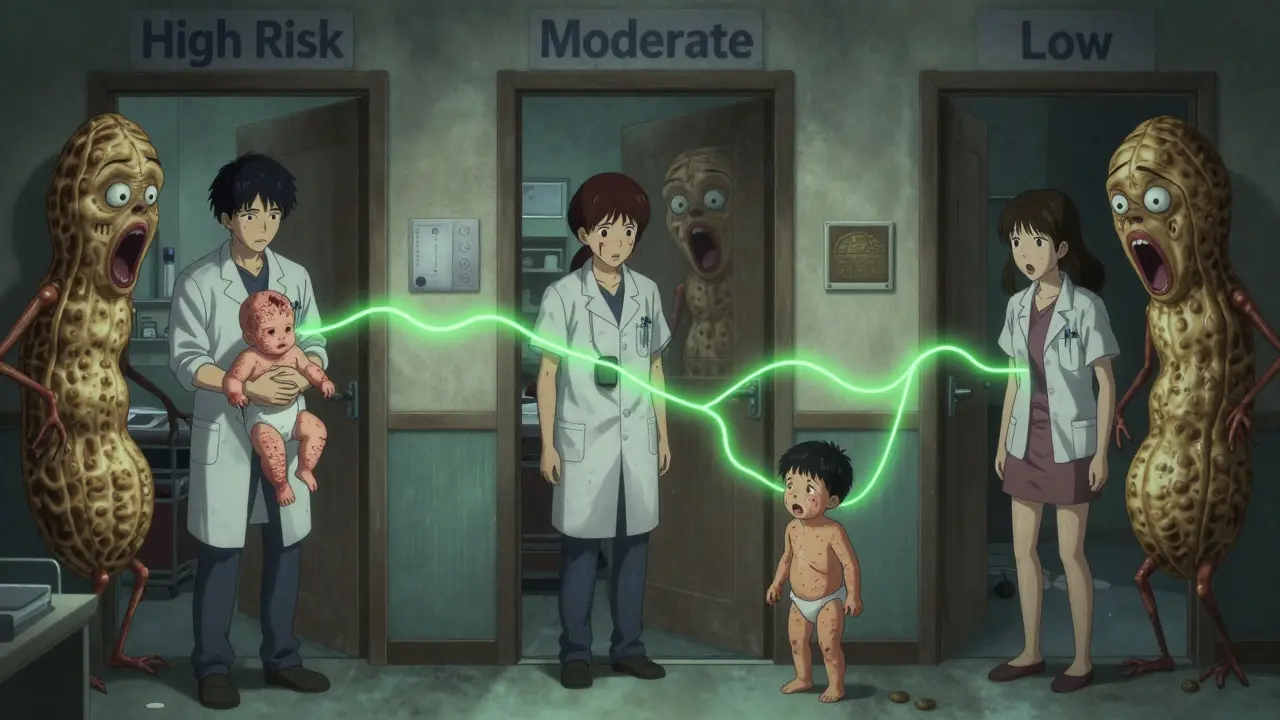
The big shift started with a study called LEAP - Learning Early About Peanut Allergy. Researchers in London gave peanut to babies at high risk for allergy - those with severe eczema or egg allergy - starting at 4 to 6 months old. Another group avoided peanut entirely. By age 5, the group that ate peanut had an 86% lower chance of developing an allergy. That wasn’t a small change. It was a game-changer. The reason? Your baby’s immune system learns what’s safe during a narrow window - right when they start solids. If peanut is kept away, the body sees it as a threat. But if it’s introduced early and regularly, the immune system learns to accept it. Think of it like learning a language. If you’re exposed to a new word every day as a child, you absorb it naturally. If you never hear it until you’re an adult, it feels foreign - even scary. The National Institute of Allergy and Infectious Diseases (NIAID) updated their guidelines in 2017 based on this. They split babies into three risk groups:- High risk: Severe eczema or egg allergy - introduce peanut between 4 and 6 months, after seeing a doctor.
- Moderate risk: Mild to moderate eczema - introduce around 6 months at home.
- Low risk: No eczema or food allergies - introduce anytime after starting solids, usually around 6 months.
A 2023 analysis of LEAP and another study called EAT showed something even more powerful: when peanut was introduced before 6 months, the reduction in allergy risk jumped to 98% in babies who stuck to the plan. Even in babies with mild eczema, the drop was 85%. That’s not luck. It’s science.
How to Introduce Peanut Safely
You can’t just hand a baby a spoonful of peanut butter. Whole peanuts are a choking hazard. Smooth peanut butter is fine - but it needs to be thinned out. For high-risk babies, doctors often recommend starting with a small amount under supervision. Here’s how:- At 3 to 4 months, talk to your pediatrician. If your baby has severe eczema or egg allergy, ask about a referral to an allergist.
- If testing shows no allergy, start with 2 grams of peanut protein - that’s about 2 teaspoons of smooth peanut butter mixed with 2 to 3 tablespoons of warm water, breast milk, or formula. Stir until it’s runny.
- Give this once or twice a week. Don’t skip. Consistency matters more than how much you give at once.
- Watch for signs of reaction: hives, vomiting, swelling, or trouble breathing. If anything happens, stop and call your doctor.
For moderate-risk babies, you can skip the doctor visit. Just mix the peanut butter into their cereal or pureed fruit. Make sure it’s smooth - no chunks. Start with a small spoonful, then wait 10 minutes. If there’s no reaction, give the rest. Do this three times a week.
Low-risk babies? Just follow your family’s routine. When you start solids, add peanut. No need to overthink it.
What About Oral Immunotherapy (OIT)?
OIT - oral immunotherapy - sounds like early introduction, but it’s not the same. OIT is for kids who already have peanut allergy. It’s a treatment, not a prevention. In OIT, a child eats tiny, carefully measured amounts of peanut protein, slowly increasing over months. The goal isn’t to cure the allergy - it’s to raise the threshold so a small accidental exposure won’t cause a reaction. Think of it like building a tolerance. A child who used to react to a crumb might now handle a whole peanut. But OIT isn’t for everyone. It’s not a quick fix. It requires weekly visits, daily dosing at home, and constant vigilance. There’s still a risk of reaction. And if you stop, the protection can fade. That’s why experts stress: early introduction is prevention. OIT is management. If your child doesn’t have a peanut allergy yet, prevention is far safer and more effective than waiting until they do.
Why So Many Parents Still Wait
Despite the evidence, only about 39% of high-risk babies in the U.S. get peanut introduced on time. Why? Many parents are scared. They’ve heard horror stories. They worry about choking. They don’t know how to prepare it. Some doctors don’t know the guidelines either - a 2023 survey found only 54% of pediatricians could correctly describe them. And then there’s the gap in access. Black and Hispanic infants are 22% less likely to get peanut early than white infants. That’s not because parents don’t care - it’s because of where they live, what their doctors know, and whether they have the resources to follow through. The good news? Australia saw the same drop in peanut allergy after updating their guidelines in 2016. A study of over 1,000 babies showed peanut allergy was five times lower when introduced around 6 months. The same pattern is happening in the U.S. - peanut allergy rates have dropped from 2.2% in 2015 to 1.6% in 2023. That’s 300,000 fewer kids with peanut allergy.What’s Next?
Research is moving fast. Scientists are now testing whether introducing multiple allergens at once - peanut, egg, milk - gives even broader protection. The PRESTO trial, funded by the U.S. government and running through 2026, is looking at the best dose and timing for high-risk babies. One thing is clear: the window for prevention is small. Waiting until age 1, 2, or 3 doesn’t help. The data shows the best results come between 4 and 6 months. And once that window closes, you can’t go back. The old advice - wait and avoid - didn’t work. The new advice - introduce early, safely, and often - does. It’s not complicated. It’s not expensive. It just takes action.Can I give my baby peanut butter straight from the jar?
No. Whole peanuts and thick peanut butter are choking hazards for babies under age 4. Always thin smooth peanut butter with water, breast milk, or formula until it’s runny. You can also mix it into infant cereal or pureed fruit. Start with a small amount - about 2 teaspoons of peanut butter diluted - to test for reactions.
What if my baby has eczema? Should I still introduce peanut?
Yes - and even more importantly. Babies with eczema, especially severe eczema, are at higher risk for peanut allergy. The earlier you introduce peanut (between 4-6 months), the more protection it offers. But if the eczema is severe, talk to your pediatrician first. They may recommend allergy testing before you start at home.
Is it too late to start if my child is already 1 year old?
If your child has never had peanut and has no allergy symptoms, you can still introduce it. But the strongest protection - up to 98% reduction in allergy risk - comes from introducing peanut between 4 and 6 months. After age 1, the benefit is much smaller. Still, introducing peanut now is safer than avoiding it forever. Just watch closely for any reaction.
Do I need to give peanut every day?
No. Three times a week is enough. The key is consistency - not frequency. Studies show that giving peanut 2 to 3 times a week, starting at 4 to 6 months, reduces allergy risk by up to 85%. Missing a day or two doesn’t ruin it. But going weeks without peanut reduces the protection. Think of it like brushing your teeth - regular, not perfect.
Can I use peanut flour or peanut powder instead of peanut butter?
Yes. Peanut flour or powder can be mixed into purees or cereal. But make sure it’s pure peanut - no added sugar or salt. The amount should still equal 2 grams of peanut protein. That’s roughly 2 teaspoons of peanut butter or 1.5 teaspoons of peanut flour. Always check the label. If you’re unsure, ask your doctor or dietitian.
Will early introduction cure my child’s existing peanut allergy?
No. Early introduction is only for prevention - for babies who don’t have a peanut allergy yet. If your child already has a diagnosed peanut allergy, early introduction won’t help. In fact, it could be dangerous. For existing allergies, talk to an allergist about oral immunotherapy (OIT), which is a separate, medically supervised treatment.
Is there a difference between organic and regular peanut butter?
No. The type of peanut butter doesn’t matter as long as it’s smooth, 100% peanuts (or peanut flour), and has no added sugar, honey, or salt. Organic, natural, or conventional - they all contain the same peanut protein. Avoid brands with added ingredients. Stick to simple ones: just peanuts and maybe salt.
Shourya Tanay
March 11, 2026 AT 14:17From an immunological standpoint, the window of immune tolerance induction is a critical period governed by dendritic cell priming and T-regulatory cell polarization. Early antigen exposure during the postnatal mucosal immune maturation phase likely promotes oral tolerance via IL-10 and TGF-β upregulation, suppressing Th2 skewing. This aligns with the LEAP trial's mechanistic underpinnings - not just correlation, but causal immunomodulation.
Kenneth Zieden-Weber
March 13, 2026 AT 08:38So we spent 20 years telling parents to avoid peanut… and the allergy rate tripled? Wow. Classic. Next they’ll tell us not to wash our hands because ‘germs build immunity.’ 😏
Donnie DeMarco
March 14, 2026 AT 09:04My cousin’s kid ate peanut butter at 5 months like a champ. Now at 3, he’ll eat a whole jar if you let him. Meanwhile my brother’s kid didn’t get any until 2 and now he’s got the allergy. I’m not saying I’m a genius, but… I told ‘em so.
Tom Bolt
March 14, 2026 AT 09:07Imagine. You’re a baby. You’ve never seen peanut. Then BAM - one spoonful and your body goes ‘NOPE.’ But if you’re fed it every day from 4 months? Your immune system goes ‘Ohhh, this is just lunch.’ Mind. Blown. This is like training your body to not panic over a sock.
LiV Beau
March 16, 2026 AT 00:52OMG I just read this and I’m crying 😭 My daughter was 10 months when we introduced peanut - I had NO idea. I feel so guilty. But I’m so glad we’re doing it now! She’s fine! 🙌 I’m telling EVERYONE. This is life-changing 💖
Adam Kleinberg
March 16, 2026 AT 07:50They say early exposure works but what about the 61% of high-risk babies who STILL get allergies despite following guidelines? That’s not science - that’s a gamble. And why do they ignore the fact that glyphosate in peanut butter might be the real culprit? Nobody talks about that
Denise Jordan
March 16, 2026 AT 21:47So… we’re supposed to give babies peanut butter now? Cool. I’ll just wait till they’re 5 and let ‘em lick it off the floor. Works for me.
Gene Forte
March 17, 2026 AT 12:53Early introduction of allergens represents one of the most significant public health breakthroughs in pediatric immunology. The evidence is robust, reproducible, and scalable. This is not merely a recommendation - it is a moral imperative to reduce preventable suffering. Let us act with clarity and conviction.
Chris Bird
March 17, 2026 AT 23:31Why do white people get to do this first? In Nigeria we feed peanut to babies at 3 months. No big deal. Now you’re making a whole science project out of it? You overthink everything.
David L. Thomas
March 19, 2026 AT 20:42The OIT vs. prevention distinction is crucial. OIT is like building a firewall around a house that’s already on fire. Early exposure is preventing the fire from starting in the first place. Two different strategies - one reactive, one proactive. The data doesn’t lie.
Bridgette Pulliam
March 21, 2026 AT 02:23It’s fascinating how cultural norms and medical advice can be so misaligned. In some communities, introducing solids early is normal. In others, it’s seen as risky. The science doesn’t care about tradition - it cares about outcomes. We need to bridge that gap.
Randall Walker
March 22, 2026 AT 21:10…and yet, 61% of pediatricians still don’t know the guidelines. 😅 So we’re telling parents to do something… but the people who are supposed to tell them… don’t know? That’s not a public health win. That’s a system failure.
Miranda Varn-Harper
March 24, 2026 AT 02:34While the data appears statistically significant, one must consider the confounding variables: socioeconomic status, access to healthcare, maternal education, and environmental toxins. To attribute the reduction in allergy rates solely to early peanut exposure is reductionist at best, and potentially misleading.
Mike Winter
March 24, 2026 AT 12:29It strikes me that the real tragedy here isn’t the allergy itself - it’s the decades of fear that kept parents from trusting nature’s design. We overcomplicated what should have been simple: feed the child, let the body learn. The immune system didn’t need our panic - it needed our patience.