

Opioid Tolerance Calculator
Understand Your Tolerance Risk
This calculator estimates your opioid tolerance level based on your dose and treatment duration. Remember: tolerance develops faster than respiratory protection, increasing overdose risk.
Results
Have you ever noticed that your pain medication doesn’t seem to work like it used to? You’re taking the same dose, but the relief isn’t there anymore-so your doctor increases it. This isn’t just you being "used to it." It’s opioid tolerance, a real, measurable change in your body that happens with regular use. And it’s one of the biggest reasons people end up on higher and higher doses, often without realizing how dangerous it can become.
What Exactly Is Opioid Tolerance?
Opioid tolerance means your body has adapted to the drug. When you first take an opioid-like oxycodone, hydrocodone, or morphine-it binds to receptors in your brain and spinal cord, blocking pain signals and sometimes creating a sense of calm or even euphoria. But after days or weeks of consistent use, those receptors start to change. They become less sensitive. The same amount of drug no longer triggers the same response. So, to get the same level of pain relief, you need more.
This isn’t addiction. It’s not about craving the drug or using it for fun. It’s a physical adaptation. The U.S. Food and Drug Administration (FDA) defines it clearly: tolerance is when exposure to a drug causes a reduction in its effects over time, requiring higher doses to achieve the same result. And it happens faster than most people expect. Studies show that up to 30% of patients on long-term opioid therapy need a dose increase within the first year.
Why Does This Happen in Your Body?
At the cellular level, your nervous system is trying to protect itself. Opioids work mainly through the mu-opioid receptor (MOR), a protein coded by the OPRM1 gene. When opioids bind to these receptors, they trigger a chain reaction that reduces pain. But with repeated exposure, your cells respond by:
- Desensitizing the receptors-making them less responsive to the drug
- Internalizing them-pulling them inside the cell so they’re no longer available on the surface
- Downregulating them-producing fewer receptors overall
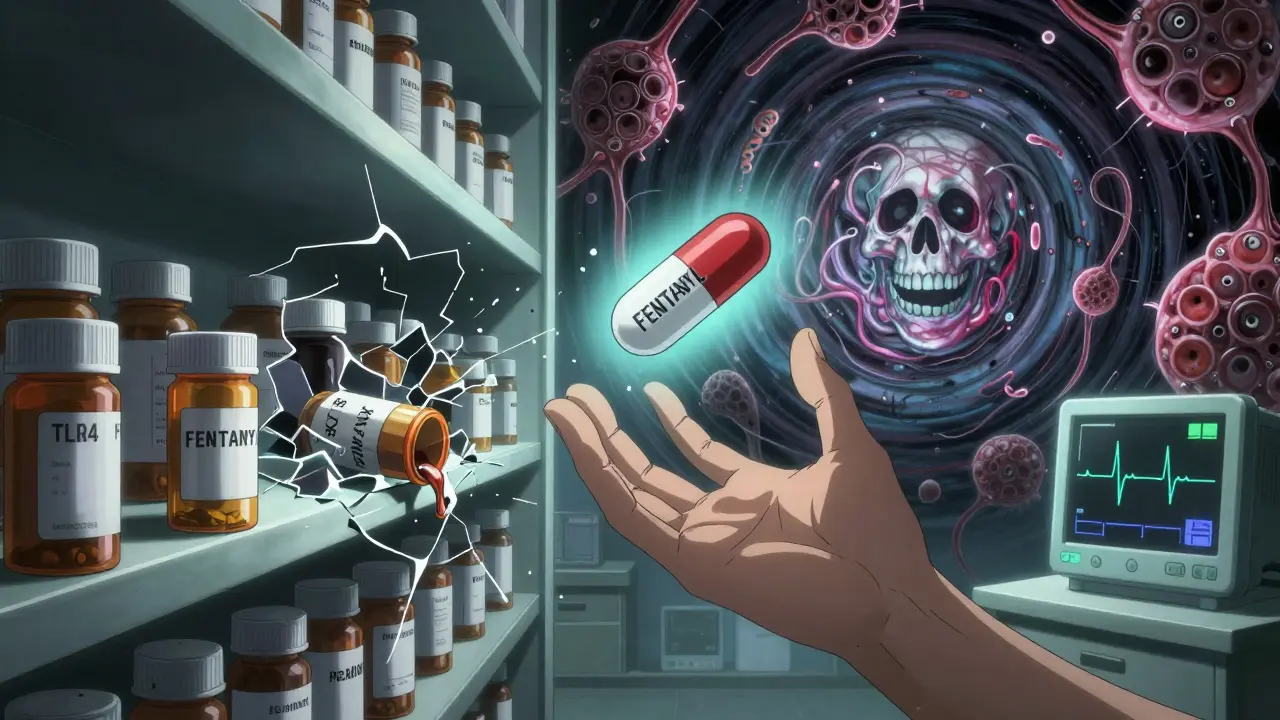
On top of that, inflammation in the nervous system plays a role. Proteins like TLR4 and NLRP3 inflammasomes get activated by opioids, which further reduces their effectiveness. This isn’t just theory-it’s been shown in lab studies and clinical observations. The British Journal of Anaesthesia found that tolerance to pain relief develops more slowly than tolerance to side effects like drowsiness or respiratory depression, which means you might still feel sleepy at your old dose, but your pain is back.
Tolerance vs. Dependence vs. Addiction
People often mix these up. They’re related, but they’re not the same.
- Tolerance means you need more of the drug to get the same effect.
- Dependence means your body has adjusted to having the drug present. If you stop suddenly, you get withdrawal symptoms-sweating, nausea, anxiety, muscle aches.
- Opioid Use Disorder (OUD) is when drug use starts causing harm: missing work, neglecting family, using despite knowing it’s hurting you.
The Centers for Disease Control and Prevention (CDC) makes this distinction clear. You can have tolerance without addiction. You can be dependent without using illegally. But tolerance is often the first step on a path that leads to bigger problems. If your dose keeps climbing and your pain isn’t improving, that’s a red flag.

Why Higher Doses Are Dangerous
Every time you increase your opioid dose, you’re moving closer to the edge. The risk of overdose rises-not just because of the drug itself, but because tolerance doesn’t protect you from everything.
Here’s the scary part: your tolerance to pain relief might go up, but your tolerance to respiratory depression (slowed breathing) doesn’t always keep pace. That means you could be taking a dose that’s safe for pain control but dangerous for your lungs. The FDA warns about this exact issue: tolerance can develop unevenly across different effects of the drug.
And then there’s the risk of relapse. If you stop taking opioids-even for a few weeks during hospitalization, rehab, or incarceration-your tolerance drops fast. The Providers Clinical Support System says patients who return to their old dose after a break are at extremely high risk of overdose. In fact, 74% of fatal overdoses among people recently released from prison happen within the first few weeks. Why? Because their bodies no longer handle the same amount they used to.
What Doctors Should Do About It
Good clinicians don’t just keep raising doses. They look for alternatives. The CDC recommends that before increasing opioids beyond 50 morphine milligram equivalents (MME) per day, doctors should reevaluate the treatment plan. That means asking: Is this still helping? Are there safer options?
Some doctors use opioid rotation-switching from one opioid to another-to reset tolerance. For example, switching from oxycodone to methadone or buprenorphine can sometimes restore pain control without increasing the total dose. Others are testing combinations like low-dose naltrexone with opioids. Early trials show this can cut the need for dose escalation by 40-60%.
Lab tests can help too. Blood tests that measure opioid levels in your system, combined with a physical exam, can tell your doctor whether you’re taking what you’re supposed to-and whether your body is responding as expected.
What You Should Know If You’re on Opioids
If you’re taking opioids for chronic pain:
- Track your pain levels and medication use. Keep a simple log: date, dose, pain score (1-10), side effects.
- If your pain isn’t improving after a few months, ask about non-opioid options-physical therapy, nerve blocks, cognitive behavioral therapy, or medications like gabapentin or duloxetine.
- Never increase your dose on your own. Even a small increase can be dangerous if your tolerance has changed.
- If you stop taking opioids-even temporarily-assume your tolerance is gone. If you restart, start with a fraction of your old dose. The CDC’s public health campaign says it plainly: "Your tolerance is lower now-start with a fraction of your previous dose."
Studies show that about 40% of chronic pain patients on long-term opioids report reduced effectiveness within six months. That’s not failure-it’s biology. And it’s why so many people end up trapped in a cycle: more pills → more side effects → more pain → more pills.
The Bigger Picture: Tolerance and the Overdose Crisis
In 2022, over 107,000 Americans died from drug overdoses. More than 81,000 involved synthetic opioids like fentanyl. Fentanyl is 50 to 100 times stronger than morphine. Someone with tolerance to prescription opioids might think they can handle a pill that looks like their oxycodone-but it’s actually laced with fentanyl. One pill can kill.
The DEA says street drugs vary wildly in potency-even within the same batch. One pill might have 0.5 mg of fentanyl. The next might have 2.5 mg. That’s a fivefold difference. People with opioid tolerance don’t realize they’re now playing Russian roulette with a drug they don’t fully understand.
Researchers are working on new opioids designed to cause less tolerance. The FDA is encouraging drug makers to prioritize compounds that maintain pain relief without triggering the body’s adaptive responses. But until those drugs are widely available, the safest approach is to use opioids only when absolutely necessary-and to have a clear exit plan.
What Comes Next?
Opioid tolerance isn’t a moral failing. It’s a biological process. But it’s also a warning sign. If your medication isn’t working like it used to, it’s not time to push harder-it’s time to rethink the whole plan.
Ask your doctor: Is this still the best option? Are there other ways to manage my pain? What happens if I try to reduce my dose? Don’t wait until you’re on a high dose to ask. The earlier you address tolerance, the more control you have over your health-and your future.
Is opioid tolerance the same as addiction?
No. Tolerance means your body needs more of the drug to get the same effect. Addiction, or opioid use disorder, involves compulsive use despite harm-like losing your job, damaging relationships, or using illegally. You can have tolerance without addiction, but tolerance often leads to it if not managed properly.
Can opioid tolerance be reversed?
Yes, but not by taking more. Tolerance decreases when you stop using opioids. Over time, your receptors return to normal sensitivity. This is why people in recovery are at high risk of overdose if they return to their old dose. It’s not about willpower-it’s about biology.
How long does it take to develop opioid tolerance?
It varies. Some people notice reduced effectiveness in just a few weeks, especially with daily use. Others may stay stable for months. Genetics, metabolism, and how often you take the drug all play a role. The CDC says about 30% of patients need a dose increase within the first year of long-term use.
What should I do if my pain medication isn’t working anymore?
Don’t increase the dose yourself. Talk to your doctor about alternatives. Non-opioid treatments like physical therapy, nerve blocks, antidepressants, or cognitive behavioral therapy can be just as effective-and safer. Your doctor may also consider switching to a different opioid or adding a medication like low-dose naltrexone to help slow tolerance.
Why is tolerance loss dangerous after stopping opioids?
Your body forgets how to handle the drug. If you used to take 60 mg of oxycodone daily and stop for a month, your tolerance drops significantly. If you then take that same 60 mg again, your body can’t handle it. Your breathing can slow to dangerous levels-or stop. This is why 65% of overdose deaths in recovery happen because people return to their old dose without adjusting.
Are there new treatments to prevent opioid tolerance?
Yes. Researchers are testing drugs that block inflammation pathways (like TLR4 inhibitors) and combination therapies using low-dose naltrexone with opioids. Early trials show these can reduce the need for dose escalation by 40-60%. The FDA is also encouraging drug companies to develop new painkillers designed to avoid triggering tolerance in the first place.
Final Thoughts
Opioid tolerance isn’t something you can ignore. It’s not a sign you’re weak or that the drug isn’t working-it’s a signal that your body has changed. And when your body changes, your treatment plan should too. The goal isn’t just to control pain. It’s to keep you safe. That means knowing when to hold off, when to switch, and when to stop. Because the dose you need today might be the one that kills you tomorrow.
Philip Leth
January 2, 2026 AT 15:56Been on oxycodone for 5 years for back pain. Same dose for 2 years, then bam - nothing. Doc upped it, now I’m at 80mg/day. Feels like my body’s been hijacked. Not addicted, just... biologically betrayed.
Angela Goree
January 2, 2026 AT 17:53THIS! Why do people keep acting like tolerance is a personal failure?! It’s biology! Your receptors get tired! It’s not weakness-it’s your nervous system screaming, ‘I CAN’T TAKE ANY MORE OF THIS!’ And then doctors just keep writing scripts like it’s a vending machine!
Joy F
January 3, 2026 AT 13:14Let’s deconstruct this on a neurophenomenological level: opioid tolerance isn’t merely pharmacokinetic-it’s an epistemic rupture between the self and its somatic apparatus. The mu-opioid receptor, once a faithful conduit of relief, becomes a hollowed-out shell, a monument to homeostatic betrayal. TLR4 inflammasomes? They’re not just proteins-they’re the immune system’s quiet revolt against chemical domination. We’re not just managing pain; we’re negotiating with a body that’s learned to resist its own salvation.
And the tragic irony? The very mechanism meant to protect you-receptor internalization, downregulation-is the same one that turns your prescribed relief into a death sentence when tolerance collapses post-abstinence. It’s not addiction. It’s a Darwinian glitch in the pharmacological contract.
Doctors still treat this like a dosage puzzle. But it’s a metaphysical crisis. You’re not taking more pills-you’re begging your neurons to remember how to feel safe.
And yet-we keep prescribing. Why? Because we’re afraid of the void where pain used to be. And because we’d rather numb the symptom than confront the system that created it.
There’s a reason why 74% of fatal overdoses happen after incarceration or rehab. It’s not recklessness. It’s amnesia. Your body forgot how to survive you.
Until we stop treating tolerance as a clinical problem and start treating it as a cultural wound, we’re just rearranging deck chairs on the Titanic of the opioid epidemic.
And yes-I’ve seen it. I’ve been there. I’m not just talking theory. I’m talking survival.
Ian Detrick
January 4, 2026 AT 22:30Man, this is the most honest thing I’ve read about pain meds in years. I was skeptical at first-thought I was just weak for needing more. But learning it’s my body adapting, not me being a junkie? That changed everything. I started PT last month. Still taking my meds, but way less. And guess what? I feel more alive. Not numb. Not high. Just... me.
Don’t let fear keep you stuck. Talk to your doc. Ask about naltrexone combos. Try acupuncture. Move your body. You’ve got more power than you think.
Palesa Makuru
January 6, 2026 AT 15:36Interesting, but I wonder-how many of you are actually following the CDC guidelines? Or are you just using this as a justification to keep your prescription? I’ve seen too many patients who ‘need’ higher doses because they refuse to engage in non-pharmacological interventions. Pain isn’t a math problem-it’s a lifestyle problem.
Hank Pannell
January 7, 2026 AT 20:49TLR4 activation and inflammasome upregulation are legit-there’s solid murine data on this. But here’s the kicker: the same pathways that cause tolerance also drive hyperalgesia. So you’re not just getting less relief-you’re actually becoming more sensitive to pain. It’s a vicious loop: more opioids → more inflammation → more pain → more opioids. The FDA’s warnings are undercooked. We need neuroimmunology to be standard in pain clinics. Not just psychiatry.
And low-dose naltrexone? It’s not experimental anymore. It’s a paradigm shift. I’ve seen patients cut their opioid use by 60% with 1.5mg LDN. Why isn’t this first-line? Because pharma doesn’t profit from it.
Lori Jackson
January 9, 2026 AT 16:57Of course your tolerance increases. You’re not trying to heal-you’re trying to escape. People don’t want to sit with their pain. They want to delete it. And doctors enable it. This isn’t medicine. It’s chemical avoidance. You think you’re managing pain? You’re managing your fear. And now your body’s paying the price.
Wren Hamley
January 11, 2026 AT 13:42My grandma took morphine for 8 years after her hip surgery. Never increased. Never got addicted. Just… managed. She did yoga, ate turmeric, meditated, and talked to her priest. Maybe the problem isn’t the drug-it’s the lack of a whole-person plan. We treat pain like a broken pipe, not a broken life.
erica yabut
January 12, 2026 AT 05:39So you’re telling me we’ve been lied to for decades? That tolerance isn’t ‘just how it is’ but a systemic failure of medical education? And now we’re just throwing more pills at it? Of course people overdose after prison-they’re being set up to die. This isn’t a crisis. It’s a massacre.
Tru Vista
January 12, 2026 AT 14:12lol so tolerance = bad? duh. i thought it was common sense. also fentanyl kills. why are we still doing this? 🙄
Vincent Sunio
January 13, 2026 AT 17:27While the biological mechanisms described are accurate, the underlying assumption-that tolerance is an inevitable and uncontrollable phenomenon-is dangerously reductionist. The medical profession has abdicated its responsibility to address psychosocial determinants of pain by defaulting to pharmacological escalation. Tolerance is not merely a receptor-level event; it is a symptom of a healthcare system that prioritizes efficiency over empathy, and pills over presence. Until clinicians are trained in narrative medicine and pain neuroscience, we will continue to treat symptoms while ignoring the suffering.