

If you have asthma and reach for an over-the-counter pain reliever like ibuprofen or aspirin, you could be setting off a silent storm in your lungs. For about 7% of people with asthma, these common drugs aren’t just ineffective-they’re dangerous. This isn’t a rare allergy. It’s a well-documented condition called NSAID-Exacerbated Respiratory Disease (NERD), sometimes known as Aspirin-Exacerbated Respiratory Disease (AERD). And if you’re not aware of it, you might keep making the same mistake-thinking it’s just a bad cold or a flare-up-until you end up in the emergency room.
What Happens When NSAIDs Trigger Asthma?
NSAIDs like aspirin, ibuprofen, and naproxen block an enzyme called COX-1. That’s how they reduce pain and inflammation. But for people with NERD, this blockage backfires. Instead of calming things down, it shifts your body’s chemistry toward inflammation. Your system starts pumping out too many leukotrienes-powerful chemicals that tighten airways, swell nasal passages, and flood your lungs with mucus. Within 30 minutes to three hours, you might feel your chest tighten, your nose clog, and your breathing turn shallow and labored.
This isn’t a mild reaction. It can look like a full-blown asthma attack: wheezing, gasping, chest pressure, and sometimes even a drop in oxygen levels. Some patients report sudden, violent nasal congestion and clear, watery discharge-so much that they think they’ve caught a cold. But it’s not a virus. It’s your body reacting to a pill you took for a headache.
Who’s Most at Risk?
Not everyone with asthma has this problem. But certain patterns make it far more likely. If you’re a woman between 30 and 50, especially if you have chronic sinus problems or nasal polyps, your risk jumps significantly. In fact, up to half of people with nasal polyps and chronic sinusitis also have NERD. That’s not a coincidence-it’s a signature.
Most people don’t develop symptoms until their 30s or 40s. It’s rare to see it before age 20. And unlike typical asthma, which often starts in childhood, NERD tends to sneak up later in life. Many patients say they had mild asthma for years, then suddenly things got worse after taking ibuprofen for a backache or aspirin for a migraine. That’s when they start connecting the dots.
Being overweight and having a history of smoking also raise your risk. And if you have family members with asthma or severe allergies, you may be more vulnerable. The condition doesn’t skip generations-it runs in families, though the exact genetic link is still being studied.
What Medications Are Safe?
If you’ve had a reaction to one NSAID, you’ll likely react to all of them. That means no ibuprofen, no naproxen, no aspirin-not even low-dose baby aspirin. The problem isn’t the brand. It’s the chemical class. Even a 75mg aspirin tablet can trigger a severe reaction in sensitive people.
So what can you take instead? Acetaminophen (Tylenol) is usually the go-to. Most NERD patients tolerate it well, even at doses up to 1,000mg. But be careful: 5 to 10% of people still react to higher doses. Stick to the lowest effective dose and avoid combination cold medicines that sneak in extra acetaminophen.
Celecoxib (Celebrex) is another option. It’s a COX-2 selective inhibitor, meaning it doesn’t block COX-1 the same way. Studies show it’s generally safe for NERD patients. But it’s a prescription drug, and it’s not for everyone-especially if you have heart issues. Talk to your doctor before switching.
And here’s the tricky part: NSAIDs hide in plain sight. They’re in cold medicines, menstrual relief pills, arthritis creams, and even some combination headache tablets. Always read the ingredient list. Look for words like ibuprofen, naproxen, ketoprofen, diclofenac, or indomethacin. If you see any of them, put it back.

What About Aspirin Desensitization?
For some patients, there’s a path forward: aspirin desensitization. It sounds counterintuitive-giving someone who reacts badly to aspirin more aspirin. But under strict medical supervision, doctors slowly increase the dose over days or weeks. The goal? Train the body to tolerate it.
When it works, the results can be life-changing. Patients report fewer asthma attacks, less need for nasal steroids, and even shrinkage of nasal polyps. Some no longer need surgery. But it’s not for everyone. It requires multiple visits to a specialized clinic, and you have to be willing to take daily aspirin afterward to keep the effect going. If you stop, the sensitivity can come back.
It’s not a cure. But for people with severe, persistent symptoms, it’s one of the few treatments that actually targets the root cause-not just the symptoms.
How to Stay Safe Every Day
Living with NERD means becoming a label detective. Here’s what you need to do:
- Carry a list of banned NSAIDs and show it to every pharmacist and doctor.
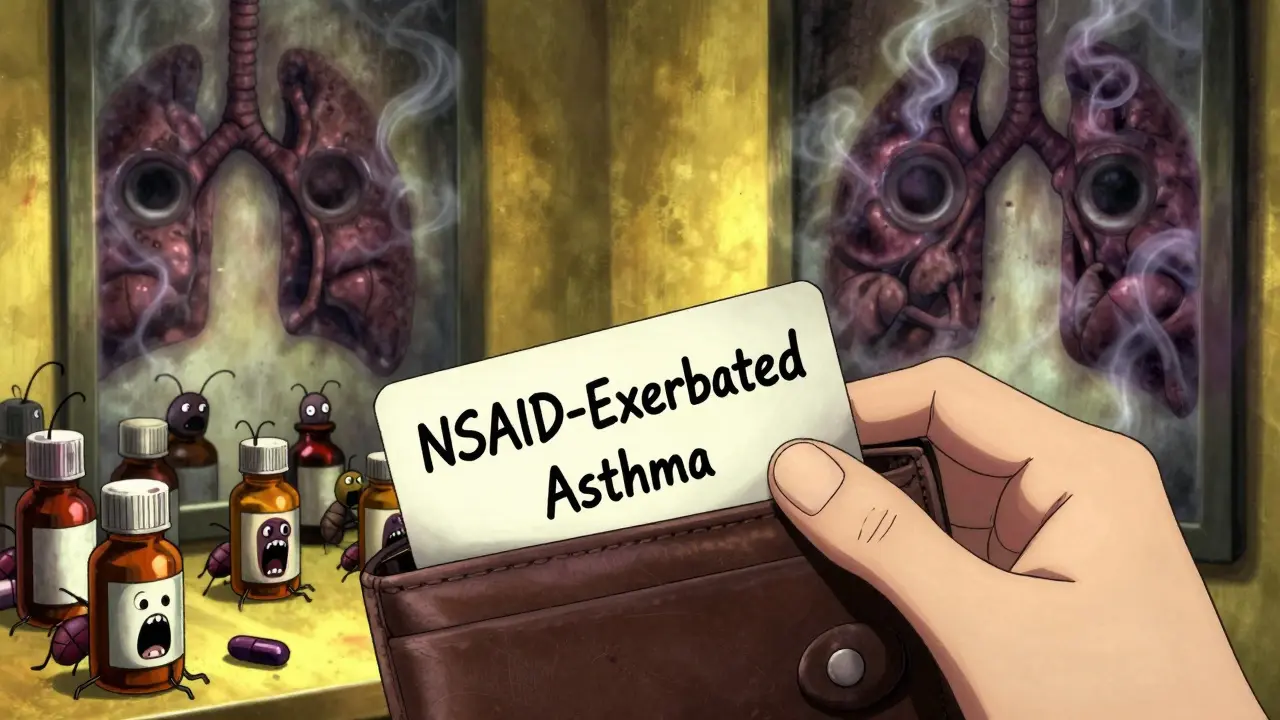
- Keep a small card in your wallet that says: “I have NSAID-exacerbated asthma. Do not give me ibuprofen, aspirin, or naproxen.”
- Use apps or websites that scan medication barcodes to check for hidden NSAIDs.
- Always ask: “Is this safe for someone with aspirin-sensitive asthma?” before taking anything new.
- Have a rescue inhaler on you at all times-even if your asthma feels under control.
Don’t assume your pharmacist knows. Not all pharmacists are trained in NERD. Even if you’ve been buying Tylenol for years, the next bottle might have ibuprofen added in a “dual-action” version. Read every label. Every time.
When to See a Specialist
If you’ve ever had a bad reaction after taking a painkiller and you have asthma or nasal polyps, you need to see an allergist or immunologist who specializes in respiratory diseases. They can run tests to confirm NERD-like a supervised aspirin challenge in a controlled setting. This isn’t something you do at home. But it’s the only way to get a definitive diagnosis.
Don’t wait until you’re gasping for air. If you’ve had two or more unexplained asthma flare-ups after taking OTC pain meds, get tested. Early diagnosis means you can avoid emergency visits, hospital stays, and long-term lung damage.
And if you’re a parent of a child with asthma, don’t assume NSAIDs are safe just because they’re “over-the-counter.” Studies show even short-term use of ibuprofen or aspirin in children with asthma can increase the risk of an asthma attack by nearly 50%. Stick to acetaminophen unless your pediatrician says otherwise.
What’s Next for NERD Treatment?
Researchers are looking at new ways to calm the inflammatory cascade that NERD triggers. One promising area is using lipoxins-natural anti-inflammatory molecules your body makes but that NERD patients seem to lack. Early trials are testing synthetic versions as nasal sprays or inhalers. The goal? To replace what’s missing without triggering more inflammation.
Another focus is better biomarkers. Blood tests for eosinophils or urinary LTE4 levels might one day help identify NERD before a reaction even happens. That could mean screening high-risk asthma patients during routine checkups instead of waiting for a crisis.
But right now, the best tool you have is knowledge. Know your triggers. Know your meds. Know your body.
Can I take Tylenol if I have NSAID-sensitive asthma?
Yes, most people with NSAID-sensitive asthma can safely take acetaminophen (Tylenol) at standard doses up to 1,000mg. But 5-10% of patients still react, especially at higher doses. Always start low, avoid combination cold medicines with hidden acetaminophen, and never exceed the recommended daily limit.
Is celecoxib safe for people with NERD?
Yes, celecoxib (Celebrex) is generally considered safe because it selectively blocks COX-2, not COX-1-the enzyme linked to NERD reactions. Multiple clinical studies support its use in patients with aspirin-sensitive asthma. However, it’s a prescription drug and not suitable for those with heart conditions. Always consult your doctor before starting it.
Do all NSAIDs trigger reactions in NERD patients?
Yes. If you’re sensitive to one NSAID like aspirin or ibuprofen, you’re likely sensitive to all of them. This includes naproxen, diclofenac, ketoprofen, and indomethacin. The reaction isn’t about the brand-it’s about the chemical mechanism. Even low-dose aspirin (75mg) can cause a severe reaction in highly sensitive individuals.
Can NERD be cured?
There’s no permanent cure, but aspirin desensitization can significantly reduce symptoms for many patients. Under medical supervision, daily aspirin therapy can improve asthma control and shrink nasal polyps. However, you must continue taking aspirin daily to maintain the benefit. Stopping can bring back sensitivity. It’s not for everyone, but for those with severe, persistent disease, it’s often life-changing.
Why do I get nasal congestion before my asthma gets worse?
In NERD, upper airway inflammation often comes first. Many patients develop chronic sinusitis and nasal polyps years before asthma symptoms become severe. This is because the same inflammatory pathway-leukotriene overproduction-affects both the nose and lungs. Nasal congestion, runny nose, and loss of smell are early warning signs. Treating nasal polyps can sometimes help improve asthma control.
Should I avoid NSAIDs if I have asthma but no nasal polyps?
Not everyone with asthma needs to avoid NSAIDs-but if your asthma is severe, poorly controlled, or started after age 30, you’re at higher risk. If you’ve ever had a reaction after taking ibuprofen or aspirin, stop using them. If you’ve never had a reaction, you can likely use them cautiously. But always have a rescue inhaler handy and watch for signs like wheezing, chest tightness, or nasal stuffiness after taking them.
MARILYN ONEILL
January 21, 2026 AT 22:20Okay but like, why do we even have these drugs if they’re just gonna kill people? I mean, I took ibuprofen for my period last week and my lungs felt like they were stuffed with cotton. I thought I was dying. Turns out I’m just one of those ‘rare’ cases. Thanks, Big Pharma.
Steve Hesketh
January 22, 2026 AT 10:34Man, this hits different. I’ve been living with asthma since I was 12, and I didn’t know NSAIDs could do this until I ended up in the ER after taking Advil for a backache. I thought I was just having a bad day. Now I carry a card in my wallet like it’s a passport. And I tell every new doctor like it’s gospel. You ain’t safe till you know what’s in that pill.
shubham rathee
January 23, 2026 AT 04:05Sangeeta Isaac
January 23, 2026 AT 18:57So let me get this straight… I’ve been taking ibuprofen for my migraines like a good little American, and now I’m supposed to be terrified of Tylenol too? Like, what’s next? Is water gonna give me asthma? I mean, I get it, I’m not a dumbass, but also… why is everything poison now? I just wanna chill with a cold brew and a pill. Is that too much to ask?
Alex Carletti Gouvea
January 24, 2026 AT 17:31This is why America needs to stop letting foreign drug companies control our medicine. We used to make real medicine here. Now we got some lab-grown chemical cocktail that turns your lungs into a balloon. If this was a Russian or Chinese drug, everyone would be screaming. But nope, it’s made in the USA, so it’s fine. Wake up.
Coral Bosley
January 25, 2026 AT 13:49I’ve been crying into my pillow for three nights straight since I realized I’ve been poisoning myself. I took naproxen for my arthritis for 12 years. I thought the wheezing was just stress. I thought the nasal drip was allergies. I thought I was just getting old. Now I’m terrified of every pill, every bottle, every damn label. I don’t even trust my own body anymore.
Dee Monroe
January 26, 2026 AT 03:57You know, this whole thing makes me think about how we treat the body like a machine you can just swap parts in and out. We slap a pill on a symptom and call it a solution. But the body isn’t a car. It’s a symphony. And when you mute one instrument-the COX-1 enzyme-you don’t just silence a note, you shatter the whole harmony. Leukotrienes aren’t villains. They’re just trying to balance the chaos we created. Maybe the real question isn’t ‘what drug is safe?’ but ‘why are we so eager to fix pain without understanding it?’
Ben McKibbin
January 28, 2026 AT 02:36Let’s be real-this isn’t about drugs. It’s about awareness. I’ve seen too many people get diagnosed after a near-fatal attack because they didn’t know to ask. And no, your pharmacist isn’t your doctor. And no, your buddy’s cousin who ‘took ibuprofen for years’ doesn’t count. If you’ve got asthma and sinus issues? Get tested. Don’t wait until you’re gasping in a waiting room. Knowledge isn’t power here-it’s oxygen.
Melanie Pearson
January 29, 2026 AT 13:42While the medical literature on NERD is robust and peer-reviewed, the dissemination of this information remains grossly inadequate within primary care infrastructure. The failure to implement standardized screening protocols for asthmatic patients presenting with recurrent upper respiratory symptoms constitutes a systemic deficiency in preventative medicine. Furthermore, the over-reliance on acetaminophen as a universal alternative lacks sufficient pharmacoeconomic justification and may contribute to hepatotoxicity epidemics in high-dose populations. A national clinical guideline is long overdue.
Uju Megafu
January 31, 2026 AT 10:05Everyone’s acting like this is some new secret. Newsflash: I’ve been telling people this for years. I’m Nigerian, and we’ve known about this since the 90s. Our grandmas told us not to give aspirin to anyone with breathing problems. Now you Americans are just catching up? Meanwhile, I’m over here reading labels like a detective while y’all are still trusting ‘sugar-free’ on the front of the box. You’re lucky you have access to this info. Now go tell your cousin who still takes Aleve for his ‘headache’.
Barbara Mahone
February 1, 2026 AT 23:48I’m a nurse in Oregon. I’ve seen this exact pattern-women in their 40s, nasal polyps, asthma that got worse after a ski trip and some ibuprofen. They always say, ‘I thought it was just the altitude.’ I hand them the list of banned meds and watch their face change. It’s not fear. It’s relief. Finally, a reason. I wish every ER had a laminated card like this pinned to the wall.
Kelly McRainey Moore
February 2, 2026 AT 04:50My mom had this. She didn’t even know until she got hospitalized after taking Advil for a toothache. Now she carries a tiny notebook with all the bad ingredients written in her handwriting. I just got her a new one. She’s 72. She still reads every label like it’s a love letter. I’m gonna do the same. Just… thank you for writing this.
Amber Lane
February 3, 2026 AT 22:52Aspirin makes me wheeze. Tylenol is my new best friend.