
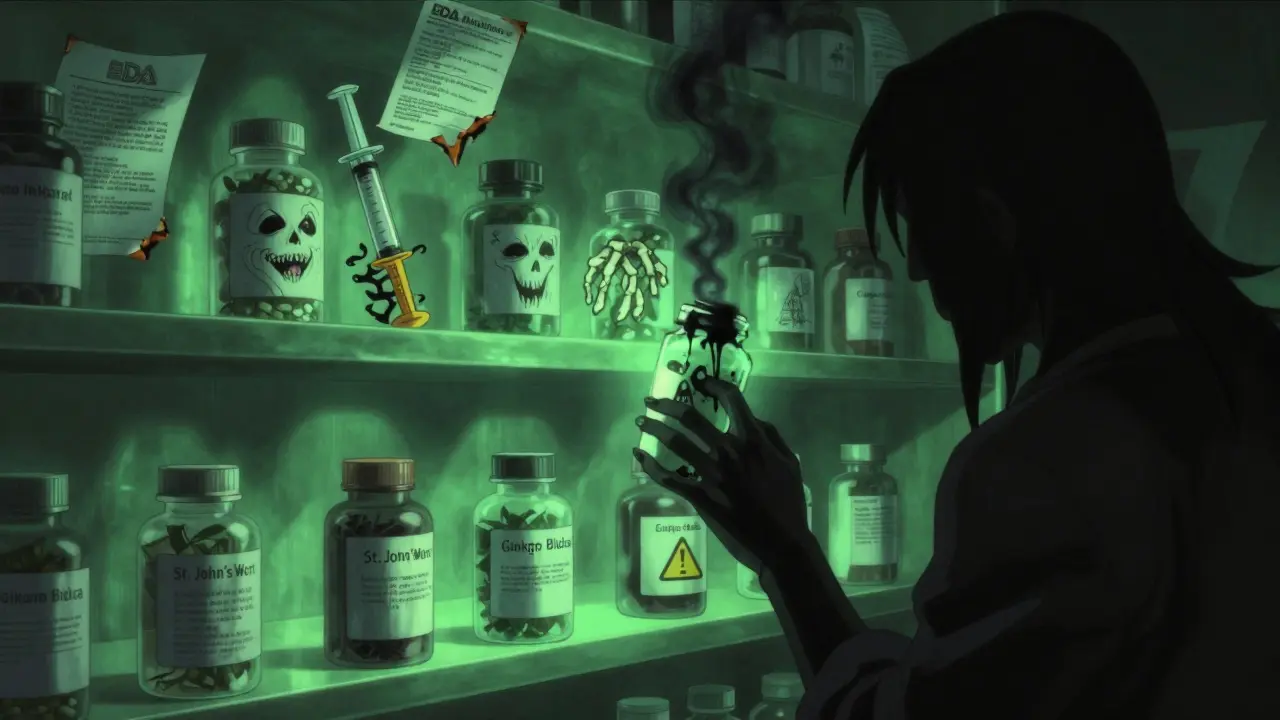
Every year, millions of Americans take herbal supplements thinking they’re harmless-just natural, safe, and maybe even helpful. But here’s the truth: the FDA doesn’t approve these products before they hit store shelves. And that’s where things get dangerous.
What the FDA Actually Does (And Doesn’t Do)
The FDA treats herbal supplements like food, not medicine. Under the Dietary Supplement Health and Education Act (DSHEA) of 1994, companies can sell products without proving they work or even that they’re safe. The only rule? Don’t make false claims like “cures cancer” or “replaces your heart medication.” But even that rule is loosely enforced.
There are over 80,000 supplement products on the U.S. market. About 75% of adults use at least one. Yet, only 1% of adverse reactions get reported to the FDA. Most people don’t know they should report side effects. And even fewer realize their doctor might not know what they’re taking.
That’s why the FDA issues warnings-not to ban products, but to flag them. These aren’t random alerts. They’re based on real cases: people hospitalized after taking “natural” weight loss pills that contained hidden stimulants, or patients bleeding uncontrollably after mixing ginkgo biloba with blood thinners.
Herbal Products That Are Riskiest
Not all herbs are created equal. Some are fine. Others? They’re ticking time bombs. Here are the top three categories the FDA warns about:
- Weight loss supplements: Over 40% of FDA warning letters target these. Many contain hidden amphetamines, diuretics, or even banned drugs like sibutramine. One product sold as “natural fat burner” was found to have the same active ingredient as a discontinued prescription weight drug linked to heart attacks.
- Sexual enhancement products: Marketed as “herbal Viagra,” these often include undeclared sildenafil (the active ingredient in Viagra) or tadalafil. Men with heart conditions who take these can suffer strokes or heart attacks-especially if they’re also on nitrates.
- “Cure-all” botanicals: Products claiming to treat diabetes, cancer, or Alzheimer’s are red flags. The FDA shut down a company selling “Miracle Mineral Solution” as a cancer treatment. It was 28% sodium chlorite-a chemical used to bleach industrial water. People who drank it ended up in emergency rooms with vomiting, low blood pressure, and kidney failure.
St. John’s Wort is another big one. It’s sold for mood support, but it can wreck the effectiveness of birth control pills, antidepressants, blood thinners, and even HIV meds. A 2018 study found over 700 supplements contained hidden drugs-41% had more than one. One pill had five undisclosed pharmaceuticals.
Why Doctors Don’t Know What You’re Taking
Doctors ask, “Do you take any supplements?” Most patients say no. Why? Because they think it’s not medicine. Or they forget. Or they’re embarrassed. But here’s what happens when they don’t tell you:
A 68-year-old man on warfarin for a blood clot started taking ginkgo biloba for memory. He didn’t mention it. Two weeks later, he had a brain bleed. He survived, but barely. The Journal of Clinical Pharmacy and Therapeutics called it a “classic case of undisclosed supplement interaction.”
Another patient took turmeric for arthritis. Unbeknownst to her, it contained undeclared steroids. Her blood sugar crashed. Her liver enzymes spiked. She ended up in the hospital. Her doctor had no idea what caused it-until he saw the label.
Studies show that when doctors use a simple 5-question checklist-“Are you taking anything? What’s it for? How much? How often? Any side effects?”-disclosure rates jump from 32% to 78%. That’s not magic. It’s just asking better questions.

What’s on the Label? (And What’s Not)
Supplement labels look official. They have a “Supplement Facts” panel. They list ingredients. But here’s the catch:
- They don’t have to list potency levels.
- They don’t have to prove the ingredients are even in the bottle.
- Botanicals must use Latin names (like Hypericum perforatum for St. John’s Wort), but many don’t.
- They must include the disclaimer: “This product is not intended to diagnose, treat, cure, or prevent any disease.” But most people miss it.
Independent testing by USP (United States Pharmacopeia) found that only 67% of non-certified supplements matched their labels. For USP-verified products? 94%. That’s a massive gap.
Look for the USP, NSF, or ConsumerLab.com seal. These third-party groups test for contamination, potency, and whether what’s on the label is actually in the bottle. They don’t guarantee safety-but they guarantee accuracy.
How to Protect Yourself
If you’re taking herbal supplements, here’s what you need to do:
- Always tell your doctor. Even if it’s “just a tea.” Even if you think it’s harmless. Your doctor needs the full picture.
- Check the FDA’s warning database. Go to the FDA website and search for your product. If it’s been flagged, stop using it.
- Look for third-party verification. USP, NSF, or ConsumerLab.com seals aren’t perfect-but they’re the best we’ve got.
- Don’t trust Amazon reviews. 18% of supplement reviews mention side effects. That’s not a feature. That’s a warning sign.
- Be skeptical of “miracle” claims. If it cures everything, it’s probably lying.
The FDA’s 2023-2027 plan aims to cut adulterated products in high-risk categories by 25%. But they’re short-staffed. Only 45 people oversee 30,000 companies. You can’t wait for regulators to protect you. You have to protect yourself.
What’s Changing?
The Dietary Supplement Listing Act of 2023 might finally change things. If passed, companies would have to list every product with the FDA before selling it. Right now, they don’t. That’s why new supplements flood the market every year-23,000 in 2023 alone.
And it’s not just about safety. It’s about accountability. Right now, if a supplement causes harm, the FDA has to prove it’s dangerous before acting. That’s backwards. Other countries require proof of safety before sale. The U.S. doesn’t.
Experts agree: the system is broken. But until Congress acts, the burden falls on you.
Final Thought
Natural doesn’t mean safe. Herbal doesn’t mean harmless. And just because a product is on a shelf doesn’t mean it’s been checked. The FDA doesn’t approve supplements. It only reacts after people get hurt.
If you’re taking anything-vitamins, teas, capsules, powders-tell your doctor. Write it down. Bring the bottle. Ask: “Could this interact with my meds?”
It’s not paranoia. It’s prevention.
Do herbal supplements need FDA approval before being sold?
No. Unlike prescription drugs, herbal supplements don’t need FDA approval before they’re sold. Manufacturers only need to notify the FDA about new ingredients, but they don’t have to prove safety or effectiveness. The FDA steps in only after a product causes harm or makes illegal claims.
Can herbal supplements interact with prescription medications?
Yes, and it’s more common than you think. St. John’s Wort can reduce the effectiveness of birth control, antidepressants, and HIV meds. Ginkgo biloba can increase bleeding risk when taken with blood thinners like warfarin. Even common herbs like garlic, ginger, and turmeric can interfere with medications. Always tell your doctor what you’re taking.
Are supplements labeled as “natural” safer?
No. “Natural” is not a regulated term. Many herbal products contain hidden pharmaceuticals, heavy metals, or contaminants. A 2013 study found 15% of tested supplements had undeclared drugs. One product labeled as “natural energy booster” contained the same stimulant as a banned weight-loss drug. Always check for third-party verification.
How can I tell if a supplement is safe?
Look for verification seals from USP, NSF International, or ConsumerLab.com. These groups test for purity, potency, and label accuracy. Also, check the FDA’s warning letter database for your product. Avoid anything that claims to cure diseases, treat cancer, or replace prescription drugs. If it sounds too good to be true, it probably is.
Why don’t doctors always know about my supplement use?
Many patients don’t disclose supplement use because they don’t think it’s medicine. Others forget, feel embarrassed, or assume it’s harmless. But studies show that 68% of doctors encounter patients who don’t mention supplements-and this leads to dangerous interactions. Always bring your supplements to appointments and answer honestly when asked.
Sumit Mohan Saxena
March 1, 2026 AT 07:19The FDA's regulatory gap in the supplement space is not an oversight-it's a systemic failure rooted in lobbying and outdated legislation. DSHEA was never meant to be a permanent framework, yet here we are, 30 years later, with no meaningful reform. The burden of safety falls entirely on consumers, who lack the training to interpret ingredient lists, detect adulterants, or understand pharmacokinetic interactions. Third-party verification seals like USP or NSF are the only reliable filters left, and even they are not foolproof. The industry thrives on ambiguity, and the public pays the price in ER visits, organ damage, and preventable deaths.
Sophia Rafiq
March 2, 2026 AT 19:51Martin Halpin
March 3, 2026 AT 00:34Let me tell you something that no one else will admit-the entire supplement industry is a pyramid scheme disguised as wellness. The FDA doesn’t ‘react after harm’-they’re complicit. They receive millions in funding from pharmaceutical lobbyists who benefit from the chaos. Why? Because if people believe herbal supplements are dangerous, they’ll turn back to Big Pharma’s overpriced, patent-protected drugs. The FDA’s 2023-2027 plan? A public relations stunt. They’re not trying to cut adulterated products-they’re trying to make you feel like you’re doing something by checking a website. Meanwhile, Amazon sellers are shipping counterfeit St. John’s Wort with hidden SSRIs from unregulated factories in China. And you think a USP seal is going to save you? Please. The entire system is designed to keep you confused, dependent, and buying more.
Eimear Gilroy
March 3, 2026 AT 16:07Charity Hanson
March 5, 2026 AT 15:18Guys I just want to say-your health is your superpower. Don’t let fear paralyze you, but DO be smart. I started bringing my supplement bottles to every appointment. My doctor was shocked I even knew what I was taking. We caught a dangerous interaction with my blood pressure med before it got worse. It’s not about being paranoid-it’s about being proactive. You’ve got this. Small steps change lives 💪
Byron Duvall
March 7, 2026 AT 06:27Everything you’re being told is a lie. The FDA doesn’t regulate supplements because they’re part of a globalist agenda to control your mind. The real danger isn’t ginkgo or St. John’s Wort-it’s the pharmaceutical-industrial complex pushing you to trust them instead. They want you to believe that only their expensive drugs are safe. But the truth? The government has been hiding the fact that synthetic drugs cause 10x more deaths than supplements. They cover it up with 'adverse event reports' that are voluntary and rarely filed. If you really want to know what’s going on, look into Operation Dark Winter and the 2018 CDC whistleblower testimony. They’re scared you’ll figure out the truth.
Full Scale Webmaster
March 8, 2026 AT 22:24Let’s not sugarcoat this: the supplement industry is a corpse dressed in yoga pants. I’ve reviewed 87 FDA warning letters in the past year. One product called 'PureZen Energy' had four different unlisted stimulants, including DMAA-a banned compound that caused strokes in teenagers. Another 'natural testosterone booster' contained trenbolone, a veterinary anabolic steroid. The labels? Printed in 6-point font. The company? Registered to a PO box in Delaware owned by a shell corporation with no employees. And here’s the kicker: the FDA only acts when someone dies or files a lawsuit. They don’t proactively test. They don’t audit. They don’t even have enough staff to inspect 1% of manufacturers. So yes, your 'natural' vitamin is probably laced with something you wouldn’t put on your dog. And no, Amazon won’t refund you. Good luck.
Angel Wolfe
March 9, 2026 AT 09:27Why are we letting foreign countries dictate what Americans can take? China, India, Mexico-they flood our market with untested junk because our government is weak. Meanwhile, we have real American companies making clean, transparent supplements, but they get crushed by regulations that only target small businesses. The real problem isn’t supplements-it’s the globalist elites who want to strip us of our right to choose what goes in our bodies. If you’re taking something labeled 'natural,' you’re not being reckless-you’re being patriotic. The FDA is just another tool of the deep state. Stop trusting bureaucrats. Start trusting yourself.
Lisa Fremder
March 9, 2026 AT 13:10My husband took that 'Turmeric Complete' for his knees. Two weeks later he had a liver transplant. The lab report said it had methyltestosterone and acetaminophen. No one warned him. No one told him to check the label. The FDA? They sent a letter three months later. By then it was too late. This isn’t about 'natural' vs 'synthetic.' This is about greed. Companies know people trust 'herbal' because it sounds clean. So they poison it with drugs they can’t patent. And we let them. Because we’re too lazy to read the fine print. We’re too proud to ask our doctors. And now people are dying. This isn’t conspiracy-it’s capitalism.
Justin Ransburg
March 11, 2026 AT 00:09Thank you for this comprehensive overview. The data presented is both alarming and necessary. The key takeaway-disclosure to healthcare providers-is not merely advisable but essential. The lack of standardized reporting mechanisms between patient, provider, and regulator creates dangerous blind spots. I urge all readers to maintain a personal supplement log, updated quarterly, and share it with their pharmacist as well as their physician. Pharmacists, in particular, are trained to detect interactions and often have access to databases that physicians do not. Proactive communication saves lives. This is not an overreaction-it is responsible self-advocacy.
Vikas Meshram
March 12, 2026 AT 04:38Correction: The FDA doesn't require notification of new ingredients. They require notification of *new dietary ingredients*-a term defined very narrowly under DSHEA. Most adulterants aren't classified as NDIs, so they fly under the radar. Also, the 23,000 new supplements in 2023? Most are variations of existing formulas with renamed ingredients to bypass the system. And St. John's Wort doesn't just reduce birth control efficacy-it can trigger manic episodes in bipolar patients. But no one tells you that because the supplement industry doesn't want you to know. They want you to believe 'natural' = safe. It's not. It's just unregulated.
Ben Estella
March 14, 2026 AT 02:42Look, I get it. You’re scared of supplements. But here’s the real issue: America’s obsession with 'natural' is what got us here. People think if it’s from a tree, it’s holy. That’s nonsense. You wouldn’t drink raw sewage because it’s 'natural.' But you’ll drink a tea made from ground roots that might have lead, arsenic, and hidden steroids? That’s not wisdom. That’s ignorance dressed up as spirituality. The solution isn’t more government regulation-it’s personal responsibility. Learn. Read. Question. Don’t just trust a label because it says 'organic' or 'non-GMO.' Those mean nothing in supplements. And stop treating your doctor like a gatekeeper. They’re not the enemy. Ignorance is.