
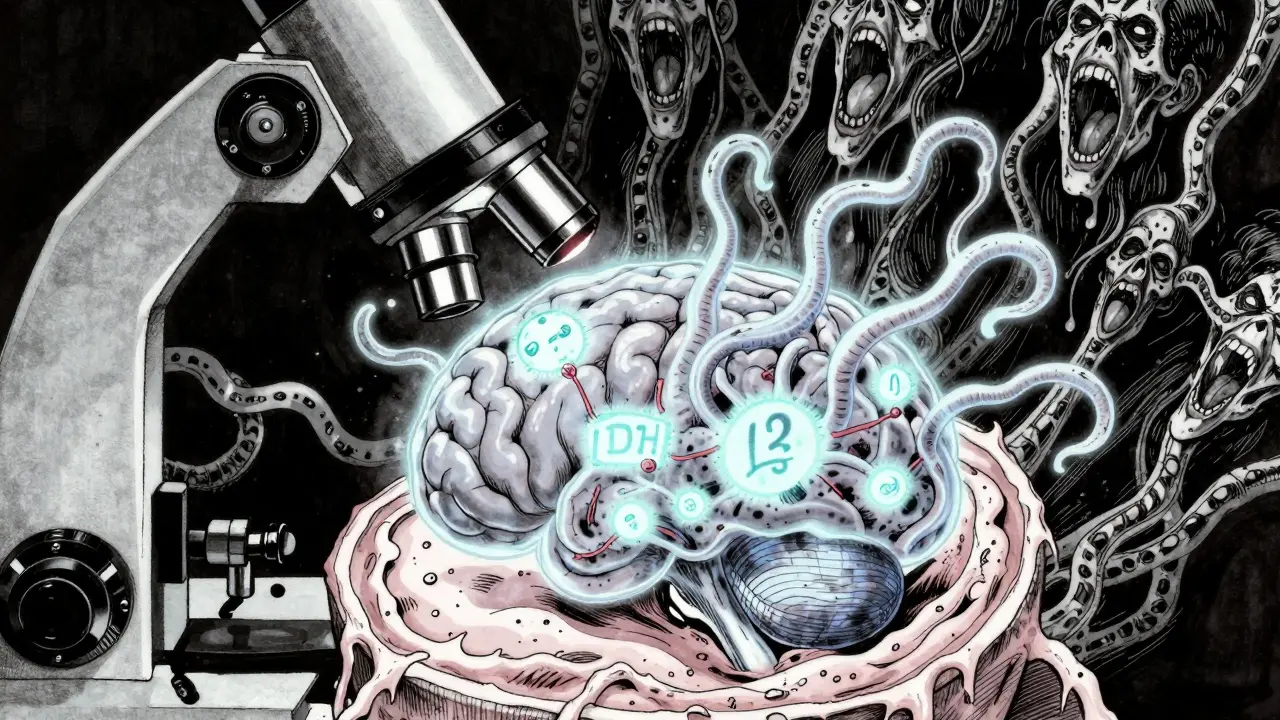
When someone hears "brain tumor," they often picture a fast-growing, deadly mass. But not all brain tumors are the same. Some grow slowly over years. Others spread aggressively within weeks. What makes the difference? It’s not just where the tumor is - it’s what kind it is and how aggressive it behaves. Today’s diagnosis isn’t just about looking at tissue under a microscope. It’s about reading DNA. It’s about molecular markers that tell doctors whether a tumor will come back, how fast it will grow, and which treatments have the best shot at stopping it.
How Brain Tumors Are Classified: Type and Grade
Brain tumors are grouped in two main ways: by their type and by their grade. Type tells you where the tumor started - like from brain cells, nerve sheaths, or the membranes around the brain. Grade tells you how dangerous it is. The World Health Organization (WHO) sets the global standard for this, and its 2021 update (CNS5) changed everything.
Before 2021, doctors looked mostly at how cells looked under a microscope. A tumor with weird shapes? Grade 3. One with dead tissue in the middle? Grade 4. But now, molecular data is required. A tumor that looks like a low-grade astrocytoma might actually behave like a high-grade one - if it has certain gene mutations. That’s why the WHO now combines histology (cell appearance) with molecular markers.
For example:
- Astrocytoma, IDH-mutant can be grade 2, 3, or 4 - depending on its mutations and growth pattern.
- Oligodendroglioma must have both IDH mutation and 1p/19q codeletion to be diagnosed. It only appears as grade 2 or 3.
- Glioblastoma, IDH-wildtype is always grade 4. No exceptions.
This shift means two tumors that look identical under the microscope can have totally different outcomes. One might be managed with observation. The other needs immediate, aggressive treatment.
Understanding the Four Grades
Grades range from 1 to 4, with 1 being the least aggressive and 4 the most. But grades aren’t universal - they depend on the tumor type.
Grade 1: Slow and Localized
These tumors look almost normal under the microscope. They grow slowly and rarely spread. The most common is the pilocytic astrocytoma, often found in children. Many can be cured with surgery alone. The 10-year survival rate is over 95%. But even grade 1 tumors can be dangerous if they’re in a critical area like the brainstem.
Grade 2: Low-Grade but Sneaky
These are infiltrative. They don’t have clear borders, so even after surgery, some cells remain. They grow slowly, but over time, they often turn into higher-grade tumors. Diffuse astrocytoma and oligodendroglioma fall here. Many patients live for years, even decades. But recurrence is common. That’s why doctors monitor them closely with MRI scans every 3-6 months.
Grade 3: Aggressive and Recurrent
Also called anaplastic tumors, grade 3 cancers divide rapidly and invade nearby brain tissue. They almost always come back. Anaplastic astrocytoma and anaplastic oligodendroglioma are examples. Treatment usually includes surgery, radiation, and chemotherapy. Survival varies - some patients live 5-10 years, but many see recurrence within 2-3 years.
Grade 4: The Most Aggressive
This is glioblastoma - the most common malignant brain tumor in adults. It grows fast, forms new blood vessels to feed itself, and has areas of dead tissue in the center. Median survival with standard treatment (surgery, radiation, and temozolomide) is 14.6 months. But there’s a twist: if the tumor has an IDH mutation, survival jumps to 31 months. That’s why molecular testing isn’t optional - it changes prognosis and treatment.
What Makes a Tumor High-Grade?
High-grade tumors (grades 3 and 4) share key features:
- Fast cell division - seen as high mitotic activity under the microscope.
- Invasion - they spread into healthy brain tissue, making complete removal impossible.
- Angiogenesis - they create their own blood supply to fuel growth.
- Necrosis - patches of dead tissue in the tumor core, a hallmark of grade 4.
But molecular traits matter even more now:
- IDH mutation - better prognosis. Found in about 10% of glioblastomas.
- 1p/19q codeletion - predicts better response to chemotherapy in oligodendrogliomas.
- MGMT promoter methylation - makes tumors more sensitive to temozolomide.
These markers don’t just help with diagnosis. They guide treatment choices. A patient with MGMT-methylated glioblastoma might get a longer course of chemo. One without it might be enrolled in a clinical trial for newer drugs.
Multimodal Treatments: More Than Just Surgery
There’s no single cure for brain tumors. Treatment is layered - or multimodal. It’s surgery, radiation, chemo, targeted therapy, and sometimes observation - all used together.
Surgery
The first step for most tumors is removal. But with brain tumors, "complete" doesn’t always mean "cured." Grade 2 and 3 tumors spread like roots. Surgeons remove what they can, but some cells remain. That’s why surgery is rarely the only treatment.
Radiation Therapy
Used after surgery for grades 2-4. It targets remaining cells. Modern techniques like proton therapy or stereotactic radiosurgery (SRS) focus radiation tightly, sparing healthy tissue. For grade 1 tumors, radiation is rarely needed. For grade 4, it’s standard.
Chemotherapy
Temozolomide is the go-to oral chemo for glioblastoma and high-grade astrocytomas. It works best when the MGMT gene is methylated. For oligodendrogliomas, PCV (procarbazine, lomustine, vincristine) is often used - especially if 1p/19q is codeleted.
Targeted Therapy
This is where things changed in 2023. The FDA approved vorasidenib for IDH-mutant grade 2 gliomas. In the INDIGO trial, patients on vorasidenib had a median progression-free survival of 27.7 months - more than double the 11.1 months seen with placebo. This is the first drug shown to delay tumor growth without radiation or chemo. For many, it means years of stable disease instead of immediate treatment.
Immunotherapy and Clinical Trials
Checkpoint inhibitors (like pembrolizumab) haven’t worked well in brain tumors so far. But new approaches are emerging - like vaccines targeting IDH mutations, or CAR-T cells engineered to find tumor-specific markers. The CODEL trial is testing combined chemo for oligodendroglioma. Results expected late 2024 could change standard care.
The Human Side: Diagnosis Delays and Misunderstandings
Getting a diagnosis isn’t just medical - it’s emotional. A 2022 study found 42% of patients thought "grade 2" meant a 20% chance of survival. It doesn’t. Grade 2 often means living 10-20 years with careful monitoring.
Delays are common. In the UK, low-grade tumor patients waited an average of 14.2 weeks for diagnosis. High-grade? Just under 10 weeks. That’s because low-grade tumors don’t always cause obvious symptoms. A headache, mild confusion, or a seizure might be dismissed as stress or migraines.
One Reddit user, diagnosed with grade 2 oligodendroglioma at 32, had 72 hours to decide on fertility preservation before surgery. That’s the reality: brain tumors don’t wait. And every day counts.

What’s Next? Liquid Biopsies and Faster Testing
Right now, getting full molecular results takes 7-10 days. Costs can hit $5,800. But new tools are cutting that down.
The FDA-approved IDH1 IHC antibody now gives results in 48 hours. Liquid biopsies - testing tumor DNA in spinal fluid - showed 89% sensitivity in a 2023 study. That means a simple spinal tap could replace some biopsies in the future.
Also, the WHO system is now using Arabic numerals (1, 2, 3, 4) instead of Roman (I, II, III, IV). Why? Because tumor behavior is a spectrum, not a box. A grade 3 tumor isn’t just "worse than grade 2" - it’s part of a continuous biological progression. The new system reflects that.
What Patients Should Know
- Don’t assume grade = death sentence. Grade 1 and 2 tumors can be managed long-term.
- Ask for molecular testing: IDH, 1p/19q, MGMT. It changes everything.
- Even if your tumor is low-grade, monitor it. It can upgrade over time.
- Ask about clinical trials. Drugs like vorasidenib are changing survival for grade 2 gliomas.
Brain tumors are no longer one disease. They’re dozens - each with its own biology, its own prognosis, its own path to treatment. The future isn’t just about removing tumors. It’s about understanding them at the DNA level - and matching each patient with the right therapy, before the tumor has a chance to change.
Charlotte Dacre
February 14, 2026 AT 07:22Virginia Kimball
February 16, 2026 AT 05:26Kaye Alcaraz
February 16, 2026 AT 20:39Mike Hammer
February 17, 2026 AT 08:24Michael Page
February 19, 2026 AT 02:48Betty Kirby
February 19, 2026 AT 10:28Josiah Demara
February 21, 2026 AT 07:37Kapil Verma
February 22, 2026 AT 12:04Erica Banatao Darilag
February 23, 2026 AT 16:52Esha Pathak
February 25, 2026 AT 07:38Joe Grushkin
February 26, 2026 AT 06:17Sarah Barrett
February 26, 2026 AT 23:09Mandeep Singh
February 28, 2026 AT 17:04